 +86-13867573512
 [email protected]
 Get a quote

 English
  Español
What damages a clutch release bearing?
Author: Heyang Date: Jan 19, 2026
Content
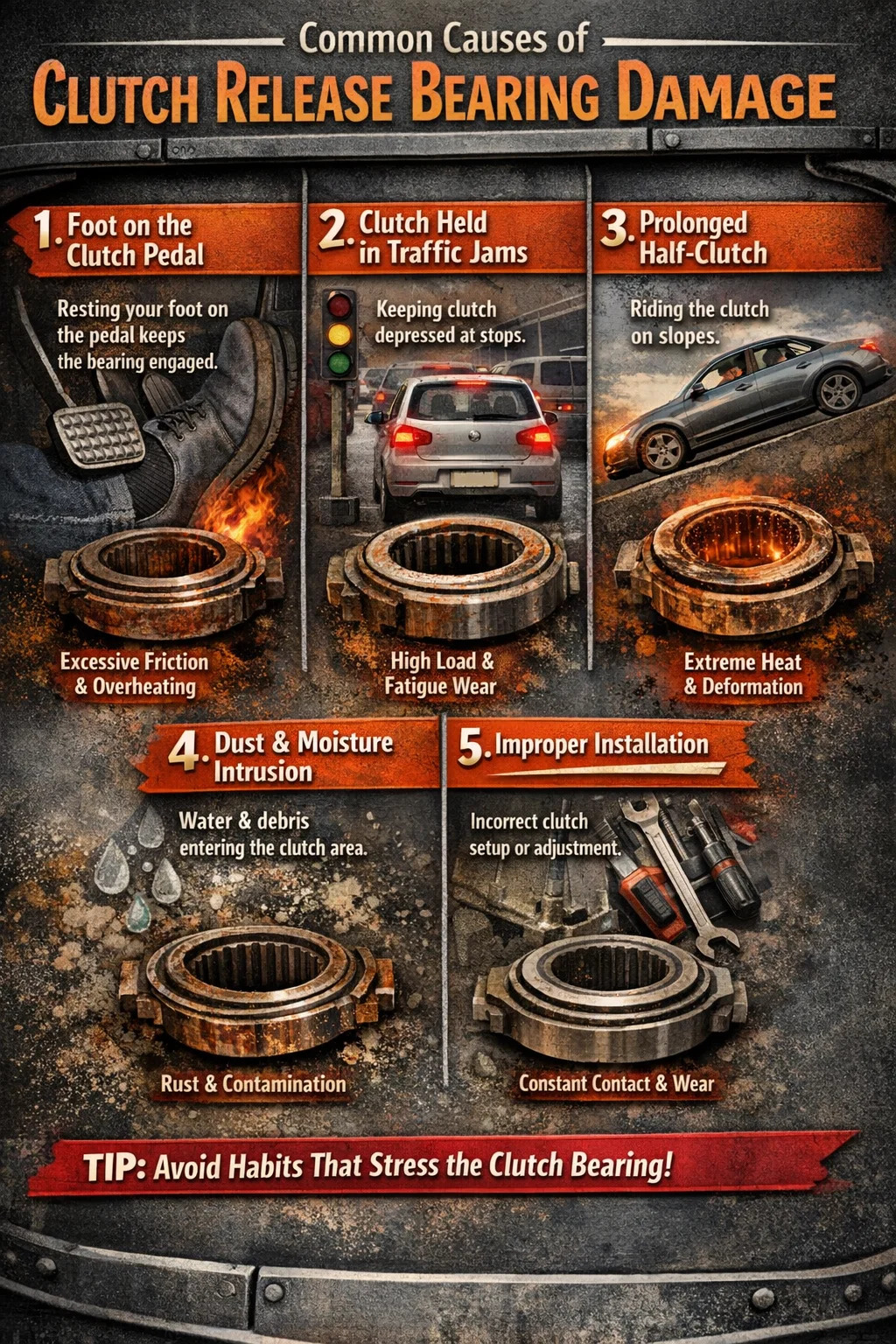
Although clutch release bearings are designed to be durable, they are also quite delicate, and many everyday habits can unknowingly shorten their lifespan. Here are some of the main reasons for their damage:
1. The Habit of Keeping Your Foot on the Clutch Pedal
This is the most common cause of bearing damage. Many drivers like to lightly rest their left foot on the clutch pedal while driving.
Consequence: Although you may not feel any pressure, this slight pressure is enough to cause the clutch release bearing to come into contact with the rapidly rotating pressure plate.
Damage: The bearing is forced to rotate continuously, causing the grease inside to thin and leak due to the high temperatures generated by continuous friction, eventually leading to the bearing burning out due to dry friction.
2. "Slow Suicide" in Traffic Jams
When waiting at a red light or in a traffic jam, keeping the clutch pedal depressed for easy starting is like "torturing" the bearing.
Consequence: The bearing is under tremendous upward thrust at this time.
Damage: Prolonged high-load operation causes fatigue wear on the steel balls and raceways inside the bearing, shortening its lifespan. Recommendations: If you stop for more than a few seconds, it's best to shift to neutral, engage the handbrake, and release the clutch.
3. Excessive Engagement Time
For example, when starting on a slope, some people keep the clutch in a "half-engaged" state for an extended period to prevent the car from rolling back, while simultaneously revving the engine.
Consequences: This operation generates tremendous heat.
Damage: The extremely high temperature is directly conducted to the clutch release bearing, causing parts to overheat and deform, or the internal lubricant to coke.
4. Dust and Moisture Intrusion
Although the clutch system is relatively enclosed, it is not a complete vacuum.
Consequences: As the clutch plates wear down naturally, a large amount of dust is generated. If the vehicle frequently drives through water, moisture may also enter the clutch housing.
Damage: Dust and moisture mixed inside the bearing will accelerate wear like a whetstone, and may even cause the bearing to rust and seize.
5. Improper Installation and Adjustment
If the clutch was not installed correctly during the last maintenance, or if the clutch cable/hydraulic system was adjusted too tightly...
Consequences: This will result in insufficient clearance between the release bearing and the pressure plate (i.e., too little free travel).
Damage: Even if you don't press the pedal, the bearing may continue to rub against the pressure plate, causing premature and silent failure.
Related Products
Contact Us

A production enterprise specializing in the production of automobile clutch bearings and other non-standard bearings.
- Contact Information
-
 +86-575-86013311
 -
 +86-575-86013322
 -
 No. 50, Tashan 1st Road, Xinchang County, Shaoxing, Zhejiang, China

Copyrigh t© Xinchang Heyang Auto Parts Co., Ltd.. All Rights Reserved.
China auto bearing manufacturers wholesale auto bearing supplier
