 +86-13867573512
 [email protected]
 Get a quote

 English
  Español
How does a clutch release bearing work? (Technical guide)
Author: Heyang Date: Dec 22, 2025
Content
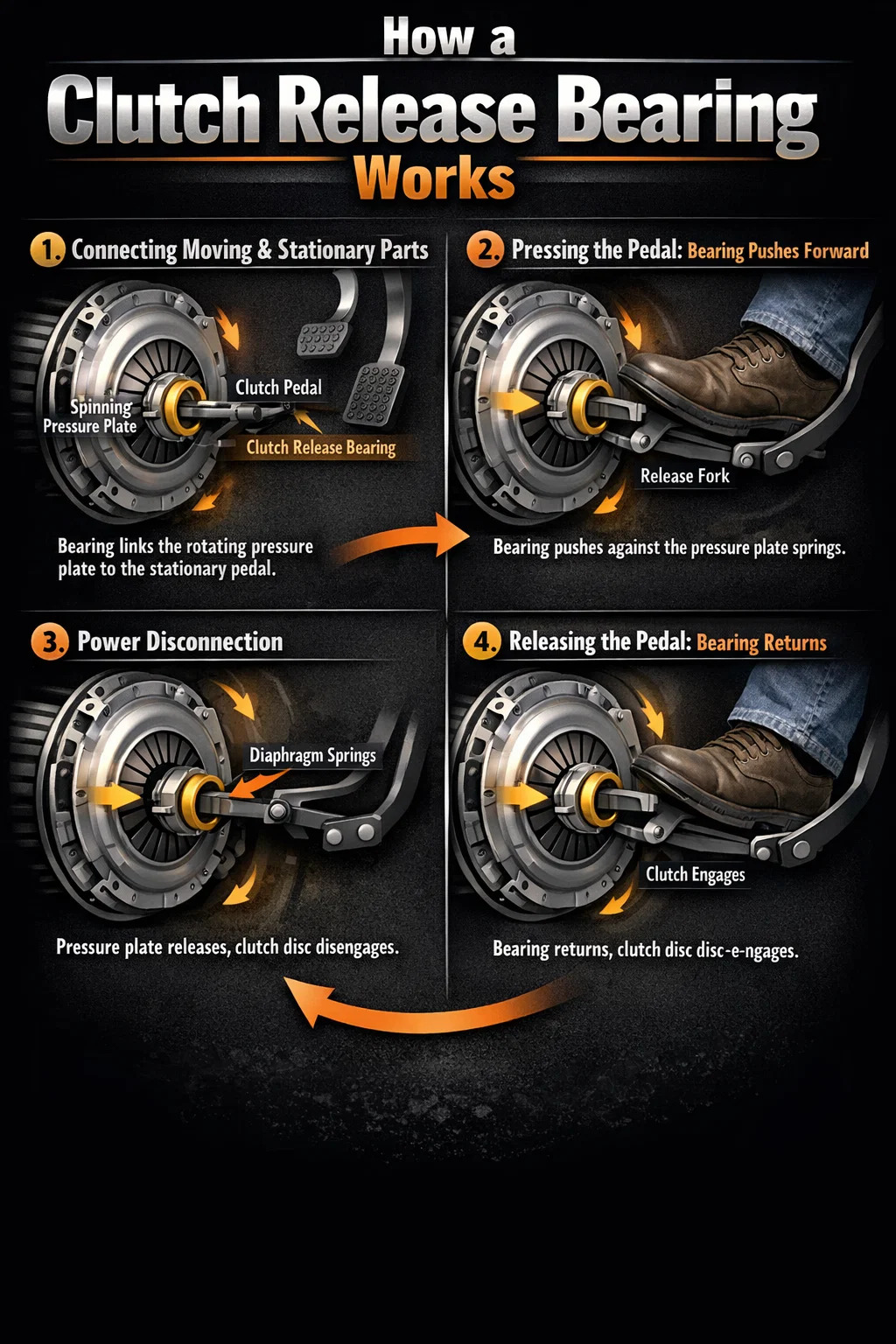
The clutch release bearing is a moving joint responsible for "transmitting pressure." Its working principle can be broken down into the following simple steps:
1. It acts as a bridge connecting the "moving" and "stationary" parts.
When the car is in motion, the engine rotates the clutch pressure plate at high speed, while your left foot and the pedal mechanism remain stationary. When you press the clutch pedal, the clutch release bearing transmits the force from your stationary foot to the rapidly rotating pressure plate, allowing them to interact.
2. Pressing the pedal: The bearing begins to "push."
When you press the clutch pedal, the force is transmitted through hydraulic fluid lines or cables to the release fork. The release fork acts like a lever, pushing the clutch release bearing forward along the gearbox shaft. At this point, one end of the bearing presses against the diaphragm springs in the center of the pressure plate.
3. Power disconnection: Due to the release of pressure.
When the release bearing pushes open the spring plates on the pressure plate, the pressure plate no longer tightly presses against the clutch disc. This prevents the engine's power from being transmitted to the gearbox, putting the car in "neutral," allowing you to shift gears or stop without stalling the engine.
4. Releasing the pedal: The bearing returns to its original position.
Once you have shifted gears and released your foot, the release fork pulls the clutch release bearing back to its original position. The pressure plate springs expand again, pressing the clutch disc tightly against the flywheel. Power is reconnected, and the car continues to move forward.
Related Products
Contact Us

A production enterprise specializing in the production of automobile clutch bearings and other non-standard bearings.
- Contact Information
-
 +86-575-86013311
 -
 +86-575-86013322
 -
 No. 50, Tashan 1st Road, Xinchang County, Shaoxing, Zhejiang, China

Copyrigh t© Xinchang Heyang Auto Parts Co., Ltd.. All Rights Reserved.
China auto bearing manufacturers wholesale auto bearing supplier
