 +86-13867573512
 [email protected]
 Get a quote

 English
  Español
Can you replace just the clutch release bearing?
Author: Heyang Date: Dec 29, 2025
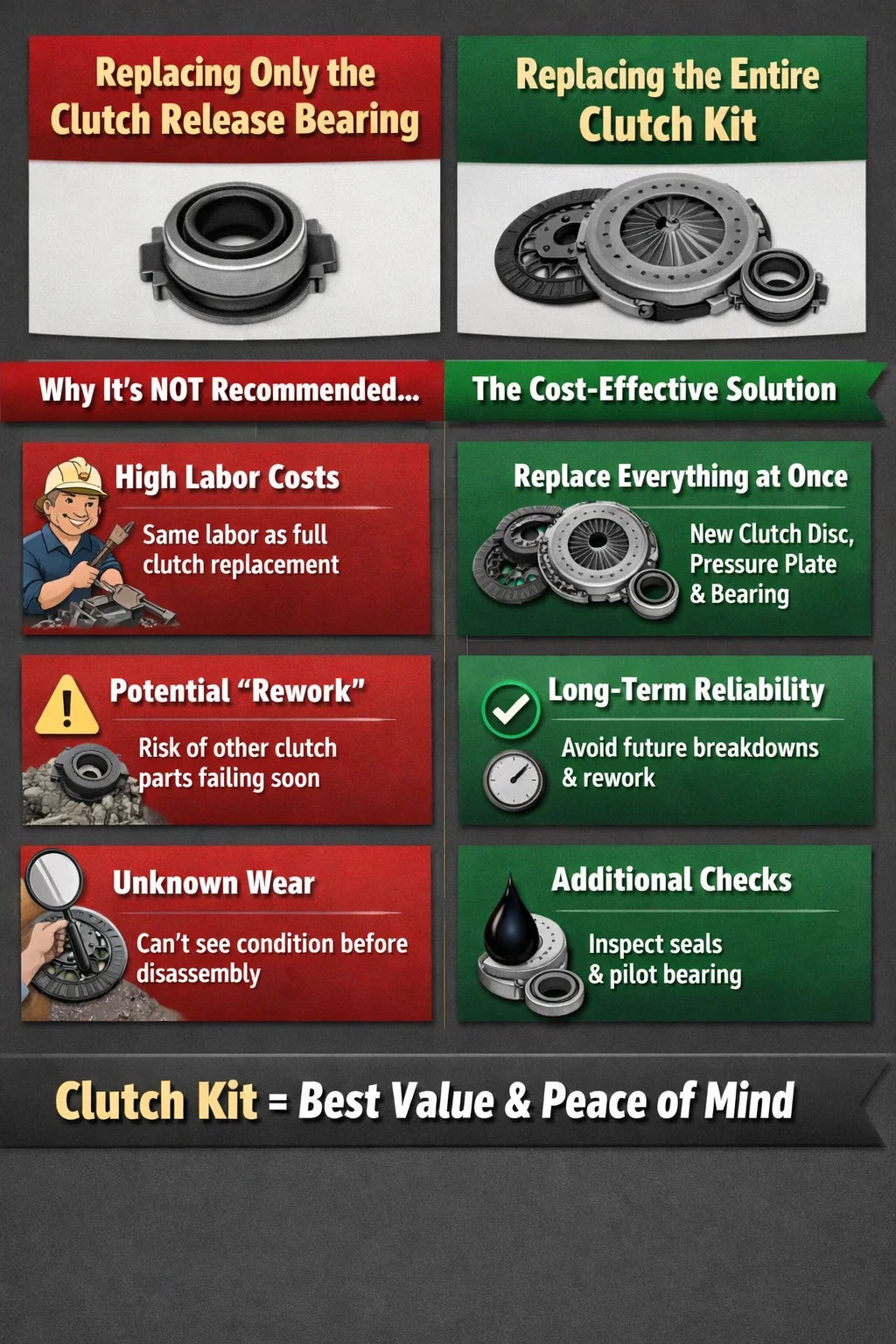
Technically, it's possible, but in practice, almost no one would recommend replacing only this one part.
Here's a detailed analysis of replacing only the clutch release bearing:
1. Why is it "possible" to replace it?
The release bearing itself is an independent part. If your car is very new, or you recently replaced the entire clutch system, and the bearing failed due to a part defect, then replacing only this bearing is physically possible.
2. Why is it "not recommended" to replace only this part?
This is mainly due to economic and efficiency considerations, for the following reasons:
High labor costs:
As mentioned earlier, to access the clutch release bearing, the mechanic must remove the entire transmission. Whether you're replacing a bearing that costs a few dozen dollars or a complete clutch system costing several thousand, the time and labor costs for removing and reinstalling the transmission are exactly the same.
Potential "rework":
The lifespan of the parts in the clutch system (pressure plate, clutch disc, release bearing) is usually similar. If you only replace the bearing this time, and the clutch disc wears out and slips a few months later, you'll have to pay the high labor costs again to have the transmission removed, which is very uneconomical in the long run.
Invisibility of part condition:
Before the transmission is removed, no one can determine the extent of wear on the clutch disc and pressure plate. Usually, after disassembly, it's found that these parts are also nearing the end of their lifespan, so replacing them all at once is the most cost-effective approach.
3. What is the most cost-effective solution?
Most experienced car owners and repair shops will recommend purchasing a clutch kit (including the clutch disc, pressure plate, and release bearing).
One-time fix:
Since the transmission is already removed, replacing all these core parts ensures that your clutch system will not have any problems for the next few years or even decades.
Additional checks:
Since it's already disassembled, the mechanic will usually also check for oil leaks in the rear crankshaft seal or the smoothness of the pilot bearing. These are minor issues that can be addressed "while they're at it."
Related Products
Contact Us

A production enterprise specializing in the production of automobile clutch bearings and other non-standard bearings.
- Contact Information
-
 +86-575-86013311
 -
 +86-575-86013322
 -
 No. 50, Tashan 1st Road, Xinchang County, Shaoxing, Zhejiang, China

Copyrigh t© Xinchang Heyang Auto Parts Co., Ltd.. All Rights Reserved.
China auto bearing manufacturers wholesale auto bearing supplier
