 +86-13867573512
 [email protected]
 Get a quote

 English
  Español
What is the lifespan of a clutch release bearing? Tips for extending its lifespan.
Author: Heyang Date: Jan 05, 2026
Content
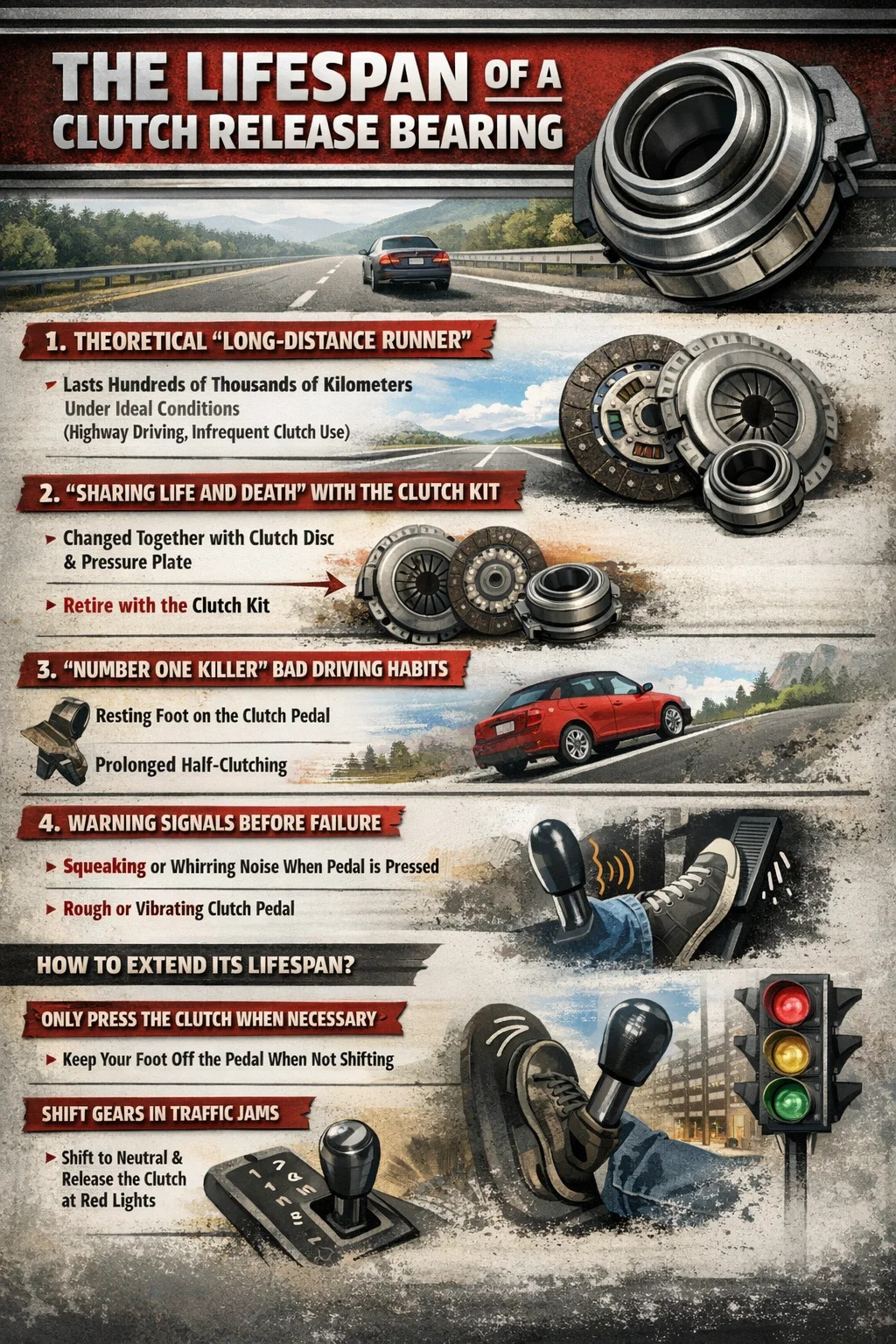
There is no absolute "shelf life" for a clutch release bearing, as it's more like a "supporting player" whose lifespan is heavily influenced by driving habits.
1. The Theoretical "Long-Distance Runner"
Under ideal driving conditions (such as frequent long-distance highway driving with infrequent clutch use), the release bearing can last a very long time, often accompanying the vehicle for hundreds of thousands of kilometers or even longer. If left undisturbed, it can often last until the entire car is scrapped.
2. "Sharing Life and Death" with the Clutch Kit
In routine maintenance, we generally consider the lifespan of the clutch release bearing to be synchronized with that of the clutch disc and pressure plate.
Most car owners, when they notice clutch slippage after a certain mileage (usually tens of thousands to hundreds of thousands of kilometers), choose to replace the bearing at the same time.
They are like a family; although the bearing may not have completely failed yet, to avoid having to disassemble the gearbox separately later to repair it, people usually let it "retire honorably" along with the entire clutch kit.
3. The "Number One Killer" of Lifespan: Bad Habits
Some people's bearings last ten years, while others' may fail in just one or two years. The difference lies in their footwork:
"Resting" habit: Many drivers like to rest their left foot lightly on the clutch pedal while driving. Although not fully depressed, this slight pressure causes the clutch release bearing to constantly rub against the rotating pressure plate. This continuous friction and heat generation rapidly depletes the lubricant in the bearing, leading to premature failure.
Prolonged half-clutching: For example, during traffic jams or hill starts, keeping the clutch in a "partially engaged" state for extended periods generates a lot of heat, directly damaging the bearing.
4. "Warning Signals" Before Failure
Although it's impossible to predict the exact day it will fail, it usually gives you a heads-up beforehand:
Noise when pressed, no noise when released: This is the most typical sign. When you press the pedal, if you hear a "squeaking" or "whirring" sound, it indicates that the ball bearings in the clutch release bearing are severely worn. Rough pedal feel: When pressing the clutch pedal, it no longer feels smooth, and there are subtle vibrations or resistance.
▶How to extend its lifespan?
Only press the clutch when necessary, and release it when not needed: After shifting gears, your left foot must completely leave the pedal and rest on the footrest.
Shift gears when stuck in traffic: When stopped for a long time at a red light, it is recommended to shift to neutral, engage the handbrake, and release the clutch to allow the clutch release bearing to rest completely.
Related Products
Contact Us

A production enterprise specializing in the production of automobile clutch bearings and other non-standard bearings.
- Contact Information
-
 +86-575-86013311
 -
 +86-575-86013322
 -
 No. 50, Tashan 1st Road, Xinchang County, Shaoxing, Zhejiang, China

Copyrigh t© Xinchang Heyang Auto Parts Co., Ltd.. All Rights Reserved.
China auto bearing manufacturers wholesale auto bearing supplier
