 +86-13867573512
 [email protected]
 Get a quote

 English
  Español
How Many Wheel Bearings Does a Car Have? Full Guide
Author: Heyang Date: May 04, 2026
Content
- 1 How Many Wheel Bearings Does a Car Have? The Direct Answer
- 2 What a Wheel Bearing Actually Does
- 3 Wheel Bearing Count by Vehicle Type
- 4 The Difference Between Sealed Hub Bearings and Serviceable Tapered Bearings
- 5 Signs That a Wheel Bearing Is Failing
- 6 How Long Do Wheel Bearings Last?
- 7 Should You Replace All Four Wheel Bearings at Once?
- 8 Wheel Bearing Replacement Cost: What to Expect
- 9 Is It Safe to Drive With a Bad Wheel Bearing?
- 10 Bearings Beyond the Wheel: How Many Total Bearings Are in a Car?
- 11 How to Extend Wheel Bearing Life
- 12 Frequently Asked Questions About Wheel Bearings
How Many Wheel Bearings Does a Car Have? The Direct Answer
A standard passenger car has four wheel bearings — one at each wheel. This is the straightforward answer for the vast majority of sedans, hatchbacks, SUVs, and crossovers on the road today. Each wheel requires its own bearing assembly to rotate smoothly while supporting the vehicle's weight, which is why the count maps directly to the number of wheels.
That said, the complete picture is more nuanced. Older vehicle designs, heavy-duty trucks, and certain axle configurations may use two bearings per wheel — an inner bearing and an outer bearing — bringing the total to eight. Modern hub-unit designs typically consolidate this into a single sealed assembly per wheel, but understanding both setups is important whether you are maintaining a daily driver or sourcing parts for a fleet.
This article covers exactly how many wheel bearings your specific vehicle type is likely to have, how those bearings function, what happens when they fail, and how to make smart decisions about inspection and replacement.
What a Wheel Bearing Actually Does
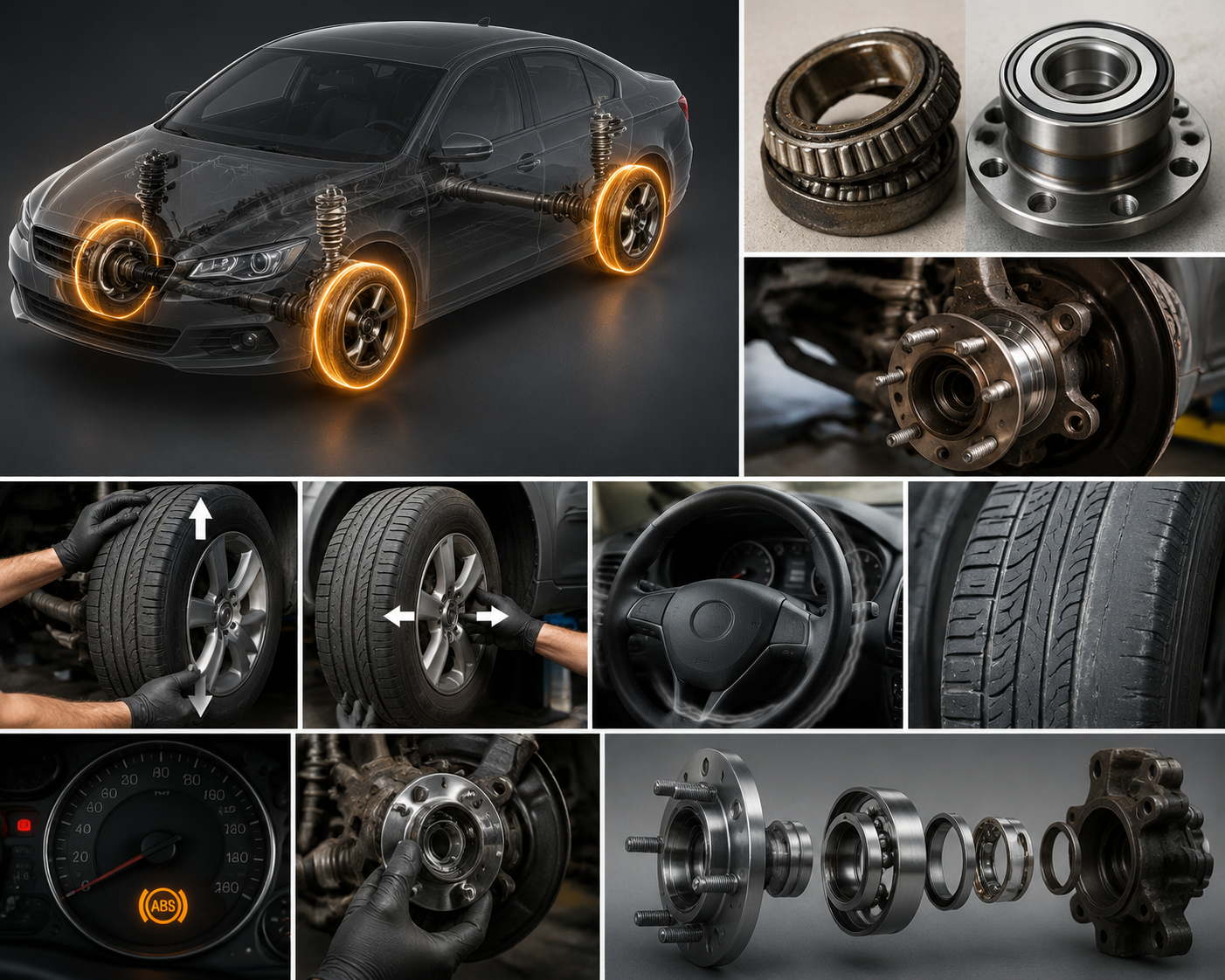
Before counting bearings, it helps to understand the job they perform. A wheel bearing is a set of steel balls or tapered rollers held in a metal ring called a race. This assembly sits inside the wheel hub — the central component that connects the wheel to the axle or spindle. The bearing allows the hub and wheel to spin freely around a stationary shaft while simultaneously carrying the full load of that corner of the vehicle.
At highway speed, the balls or rollers inside a bearing can be roughly the diameter of a pencil, and there are typically 12 to 20 of them arranged around the circumference of the race. Each individual bearing must handle enormous forces: the static weight of the vehicle, dynamic loads from acceleration and braking, lateral forces from cornering, and constant high-speed rotation. It is a mechanically demanding role for a relatively compact component.
Key functions of a wheel bearing include:
- Reducing friction between the rotating wheel assembly and the stationary axle or spindle
- Supporting the full vertical weight of the vehicle at each corner
- Absorbing lateral (side-to-side) forces generated during steering and cornering
- On driven wheels, transmitting rotational torque from the driveshaft to the wheel without excess heat or resistance
- Providing a precise mounting surface for ABS wheel speed sensors in modern vehicles
Without a functional bearing at each wheel, smooth rotation is impossible. A failed bearing creates friction, heat, noise, and — in the worst cases — allows the wheel to develop dangerous play or even detach from the vehicle entirely.
Wheel Bearing Count by Vehicle Type
The number of wheel bearings a vehicle has depends heavily on its drivetrain layout, axle design, and overall purpose. The table below summarizes typical configurations across common vehicle categories.
| Vehicle Type | Typical Wheel Bearing Count | Notes |
|---|---|---|
| Standard passenger car (FWD/RWD/AWD) | 4 | One sealed hub-unit bearing per wheel |
| Older / classic cars (pre-1990s) | 8 | Inner and outer tapered roller bearings at each wheel |
| Light truck / pickup (2-axle) | 4–8 | Depends on model year and axle type; some use dual bearings on rear axle |
| Heavy-duty truck / semi (multi-axle) | 8–20+ | Additional axles multiply bearing count; dual-wheel axles use extra bearings |
| Motorcycle | 2–4 | One to two bearings per wheel depending on hub design |
| Bus / coach | 8–16 | Larger vehicles often retain the inner/outer bearing arrangement |
Front-Wheel Drive Vehicles
Front-wheel drive (FWD) cars are among the most common layout in the world. In these vehicles, the front bearings carry a particularly demanding workload because they must handle steering forces, drive torque from the half-shafts, and vertical load all at once. For this reason, FWD front hub bearings tend to wear faster than rear bearings and may need replacement sooner. The rear wheels on a FWD car carry no drive torque, so their bearings work in a simpler environment and generally last longer. Total bearing count: four.
Rear-Wheel Drive Vehicles
In rear-wheel drive (RWD) configurations, the rear bearings manage drive torque while the front bearings handle steering loads. The rear axle in older RWD trucks often used a live-axle design with tapered roller inner and outer bearings on each side — giving a count of four wheel bearings on the rear axle alone. Modern RWD passenger cars have moved to sealed hub units, returning to the simpler four-bearing total.
All-Wheel Drive and Four-Wheel Drive Vehicles
AWD and 4WD vehicles still have four main wheel bearings — one per wheel. However, the drivetrain itself contains additional bearings in the transfer case, center differential, and prop shafts. These are not wheel bearings in the strict sense, but they are bearings that require the same level of attention and periodic service. In some performance-oriented AWD systems, the hub assemblies themselves may contain more complex bearing arrangements to manage higher loads, but the count at the wheel stays at four for most production vehicles.
The Difference Between Sealed Hub Bearings and Serviceable Tapered Bearings
Understanding the two primary bearing designs helps clarify why older cars sometimes count eight wheel bearings while modern cars count four.
Sealed Hub-Unit Bearings (Modern Design)
From roughly the mid-1980s onward, manufacturers began transitioning to pre-packaged, sealed hub-unit bearings. These units contain two rows of ball bearings inside a single housing, press-fitted or bolted directly to the knuckle or axle flange. They come pre-greased and pre-adjusted from the factory, require no field servicing, and are replaced as a complete assembly when worn. A key advantage is that they often integrate the ABS tone ring, simplifying the overall wheel end design. When this unit fails, you replace the entire hub bearing assembly — one component, one bearing count per wheel.
Serviceable Tapered Roller Bearings (Older Design)
Traditional wheel assemblies used separate inner and outer tapered roller bearings packed with grease and retained by a nut and cotter pin arrangement. These bearings required periodic re-packing with fresh grease and precise preload adjustment — a skill that demanded care to get right. Too loose and the wheel wobbles; too tight and the bearing overheats. This setup was common on rear-wheel drive cars and trucks through most of the 1970s and 1980s. Each wheel had two discrete bearings, giving a total of eight bearing components for a four-wheel vehicle. Many classic cars and older trucks still in service use this configuration.
The practical implication: if someone asks "how many wheel bearings does my car have?" and is working on a 1975 pickup, the honest answer is eight. If they are working on any typical car built after 1990, the answer is almost certainly four.
Signs That a Wheel Bearing Is Failing
One of the most practical reasons to understand how many wheel bearings a car has is to be able to diagnose which one is causing a problem. Bearing failure rarely announces itself all at once — it typically progresses through recognizable stages that give a driver time to respond before a dangerous situation develops.
Grinding or Humming Noise That Changes With Speed
The most common symptom of a failing wheel bearing is an audible grinding, growling, or humming noise that intensifies as vehicle speed increases. Unlike tire noise, which tends to be consistent, a bearing noise often changes in pitch or volume when the steering wheel is turned slightly. Turning left shifts weight onto the right-side bearings and unloads the left — if the noise changes during a gentle lane-change maneuver, this is a strong indication that one of the wheel bearings on the louder side is worn. Mechanics routinely use this technique when diagnosing bearing complaints during a test drive.
Steering Wheel Vibration
As a bearing's internal balls or rollers become pitted or worn, they no longer roll smoothly. The resulting irregularity can transmit vibration up through the suspension and into the steering wheel. This symptom tends to be gradual — drivers often adapt to a slowly worsening vibration and miss the early warning. It is worth noting that vibration can also be caused by wheel imbalance or worn tires, so a proper diagnosis involves ruling those out before condemning the bearing.
Wheel Play or Looseness
With the vehicle safely raised off the ground on a lift or jack stands, grasp the tire at the 12 o'clock and 6 o'clock positions and push-pull. Any discernible movement — commonly called play — indicates internal bearing wear. Repeat at the 3 o'clock and 9 o'clock positions to check for lateral play. A healthy sealed hub bearing should have essentially zero play. Even a few millimeters of movement is cause for prompt replacement.
Uneven Tire Wear
A severely worn bearing allows the wheel to lean slightly due to internal play, which causes the tire contact patch to be uneven. This accelerates wear on one edge of the tire. While uneven wear has many potential causes (alignment, tire pressure, worn suspension components), a failed bearing at the affected corner is always worth inspecting if other causes have been ruled out.
ABS Warning Light
Modern hub assemblies integrate the ABS wheel speed sensor tone ring. When a bearing wears to the point that the tone ring shifts position relative to the sensor, the ABS control module detects an erratic signal and illuminates the ABS warning light. This is a reliable electronic indicator that something is mechanically wrong at one of the wheel ends, and a diagnostic scan can point to which corner is misbehaving.
How Long Do Wheel Bearings Last?
Under normal driving conditions, most modern sealed hub bearings are designed to last 85,000 to 100,000 miles (roughly 137,000 to 160,000 kilometers). Some vehicles see bearings that last well beyond this range; others fail noticeably sooner. The variance comes down to a combination of factors that accelerate internal wear.
- Road surface quality: Potholes, rough pavement, and unpaved roads deliver sharp shock loads directly to the bearing. A single hard pothole strike at speed can crack the internal race of a bearing, starting a failure process that plays out over subsequent miles.
- Water and contamination exposure: Bearings rely on sealed grease for lubrication. When seals degrade — through age, extreme heat from brakes, or physical damage — water, salt, and road grit can infiltrate the assembly and displace the grease. Vehicles driven in coastal environments or regions with heavy road salt use often see premature bearing failure.
- Wheel and tire dimensions: Installing oversized wheels or tires increases the lever arm acting on the bearing, raising the effective load. Vehicles that are regularly driven with non-standard wheel sizes — especially wider, heavier aftermarket wheels — will tend to experience shorter bearing life.
- Vehicle load: Regularly carrying heavy loads or towing places bearings under greater stress than they were designed for in everyday use. Commercial vehicles and frequently loaded trucks will go through bearings more quickly than an unloaded passenger car.
- Driving style: Aggressive cornering at speed puts lateral forces on wheel bearings that far exceed normal driving. Track days and spirited country road driving shorten bearing life measurably compared to gentle urban commuting.
- Wheel alignment: Incorrect toe or camber settings cause the tire to scrub sideways as it rolls, transmitting abnormal side loads into the bearing continuously. Even a modest misalignment, if left uncorrected for thousands of miles, will wear bearings well before their expected service life.
Should You Replace All Four Wheel Bearings at Once?
This is a common question — and the answer depends on the context. Unlike brake pads, where replacing both sides of an axle simultaneously is standard practice for safety and balance, wheel bearings do not strictly need to be replaced in sets unless they show signs of wear.
If one bearing has failed, inspecting the remaining three is essential. Bearings on the same axle may share similar operating conditions and age, and if the failed bearing had been noisy for an extended period (meaning the car was driven on it for a while), the opposite bearing may be approaching failure as well. In that case, replacing the axle pair is a reasonable precaution that saves on future labor costs, since much of the work is the same anyway.
For vehicles with high mileage — say, beyond 120,000 miles — some mechanics recommend replacing all four bearings during a comprehensive service, particularly if two have already been replaced and the remaining two are original. The cost of parts is considerably lower than the cost of having a wheel bearing fail unexpectedly and potentially damage the hub, knuckle, or ABS components in the process.
For a lower-mileage vehicle where only one bearing has clearly failed and the others show no play, noise, or wear, replacing only the bad unit is entirely reasonable and cost-effective.
Wheel Bearing Replacement Cost: What to Expect
Replacement cost varies significantly by vehicle type, location, and whether you visit a dealership or an independent shop. The following ranges reflect general market conditions and should be used as a starting point for getting accurate local quotes.
| Vehicle Category | Parts Cost (Per Bearing) | Labor Cost (Per Bearing) | Total Estimate (Per Bearing) |
|---|---|---|---|
| Economy / compact car | $30–$100 | $80–$150 | $110–$250 |
| Mid-size sedan / SUV | $60–$150 | $100–$200 | $160–$350 |
| Luxury / European brand | $100–$300 | $150–$250 | $250–$550 |
| Light truck / pickup | $80–$200 | $100–$220 | $180–$420 |
Labor cost is often the larger variable. Some hub bearings are straightforward bolt-on replacements that take under an hour; others require pressing the bearing into the knuckle using a hydraulic press, which is more time-consuming and requires specialized equipment that independent shops may or may not have. If a bearing must be pressed in, confirm that the shop has the correct tooling for your specific vehicle before committing to the job.
One practical tip: if you are having two or more bearings replaced at the same time, ask for a combined labor rate. Much of the disassembly work (removing the wheel, brake components, and hub) overlaps between bearings on the same axle, and a reasonable shop will reflect that in the total bill.
Is It Safe to Drive With a Bad Wheel Bearing?
The short and honest answer is: no, not for long. A bearing in early-stage failure — producing a faint hum — may be tolerable for a short period while arranging a repair appointment, but continuing to drive on a bearing that is generating loud grinding, vibration, or measurable wheel play is genuinely dangerous and likely to cause further, more expensive damage.
When a bearing deteriorates badly enough, several failure modes become possible:
- Wheel seizure: In extreme cases, the bearing can lock up, causing the wheel to drag or stop rotating. At highway speed, this is catastrophic.
- Hub damage: A worn bearing chewing against the hub can destroy the hub itself, turning a straightforward bearing replacement into a much more expensive hub assembly or knuckle replacement.
- Loss of vehicle control: Severe wheel play from a failed bearing degrades steering precision and stability — especially in emergency maneuvers where the vehicle is already at the limits of its handling.
- ABS and traction control loss: A failed bearing that damages the integrated tone ring can disable ABS and electronic stability systems precisely when they are most needed.
The moment a mechanic or inspection confirms a bad bearing, scheduling the repair promptly is the correct course of action.
Bearings Beyond the Wheel: How Many Total Bearings Are in a Car?
While this article focuses on wheel bearings specifically, it is worth noting that a modern car contains many more bearings throughout its systems. Bearing manufacturer research suggests that a typical passenger car contains a minimum of 36 bearing assemblies when all components are accounted for — and this number climbs rapidly with optional features and powertrain complexity.
Beyond the four wheel bearings, other bearing locations include:
- Engine bearings: Main bearings support the crankshaft; rod bearings connect the connecting rods. A four-cylinder engine typically has five main bearings and four rod bearings. A V8 has nine main and eight rod bearings. These are plain (sleeve) bearings rather than rolling-element bearings, but they are critical components that rely on oil film pressure.
- Camshaft bearings: Supporting the camshaft in overhead-cam engines. Dual overhead-cam engines can have up to 20 cam bearings.
- Transmission bearings: Manual gearboxes use 6 to 12 rolling-element bearings to support the input and output shafts and differential. Automatic transmissions use fewer but larger bearings.
- Accessory bearings: Alternators, power steering pumps, air conditioning compressors, and starter motors all contain their own rolling-element bearings — typically two per component.
- Steering column bearings: Multiple needle bearings in the universal joints and column support the steering input from driver to rack.
- Driveline bearings: In RWD and AWD vehicles, carrier bearings support the propeller shaft; center support bearings locate multi-piece shafts.
The total bearing count in a well-equipped modern car can exceed 100 individual bearing components across all systems. Wheel bearings are simply the most driver-visible category because their failure has the most immediate and obvious effects on handling and noise.
How to Extend Wheel Bearing Life
Since replacing all four wheel bearings can cost between $400 and $1,400 or more depending on the vehicle, extending their service life through good habits is worth the effort. The following practices make a measurable difference:
- Avoid driving through deep water or flooded roads at speed. Water forced past wheel bearing seals at high velocity can compromise the internal grease and accelerate corrosion of the rolling elements.
- Keep wheel alignment within factory specifications. Have alignment checked after any significant suspension impact, curb strike, or at every 12 months as a general maintenance item. Correct alignment is one of the single most effective ways to preserve bearing life.
- Avoid overloading the vehicle. Repeated operation at or beyond the vehicle's gross vehicle weight rating accelerates bearing wear. If you regularly haul heavy loads, consider whether your vehicle is rated appropriately for the task.
- Check for wheel play during tire rotations. Every time your tires are rotated — roughly every 5,000 to 7,500 miles — ask the technician to check for bearing play at all four corners. Catching a developing bearing issue early is far less expensive than waiting for full failure.
- Slow down for potholes and rough surfaces when avoidance is not possible. The shock load delivered to a bearing by hitting a pothole at 40 mph is dramatically higher than hitting the same pothole at 15 mph. This seems obvious, but it is one of the most controllable factors affecting bearing longevity on urban roads.
- Use correctly sized wheels and tires. Stay within the manufacturer's specified wheel and tire dimensions. Wider, heavier wheels increase the bending moment at the bearing and raise operating loads proportionally.
Frequently Asked Questions About Wheel Bearings
Do all four wheels always have bearings?
Yes. Every wheel on a car — front or rear, driven or non-driven — must have a bearing to allow it to rotate relative to the suspension. There is no wheel design that eliminates this requirement.
Can a wheel bearing failure cause a wheel to fall off?
In theory yes, though it requires catastrophic failure rather than the typical gradual wear process. A complete bearing collapse can allow the hub to separate from the spindle, resulting in wheel detachment. This is a genuine safety risk and the reason why driving long distances on a known bad bearing is genuinely dangerous rather than merely inconvenient.
How can I tell which of the four wheel bearings is bad?
The most reliable technique is the weight-shift method during a test drive: if the noise gets louder when turning left, the bad bearing is likely on the right side (weight transfers onto it); if the noise increases turning right, the left side is suspect. Checking for play with the wheel off the ground at each corner confirms the diagnosis. A diagnostic scanner can also identify which ABS sensor is reporting erratic data if the light is on.
Are rear wheel bearings different from front wheel bearings?
On most modern FWD cars, the rear bearings are simpler because they do not carry drive torque. Front bearings on FWD vehicles handle more complex combined loads. On RWD cars, rear bearings are driven but front bearings only handle steering loads. The physical bearing design may be similar, but part numbers are vehicle-specific and front and rear assemblies are not usually interchangeable even on the same vehicle.
What happens if I ignore a bad wheel bearing for months?
The bearing will continue to deteriorate. Internal surfaces that were once smooth become pitted and rough. The grease breaks down further. Play increases, noise intensifies, and eventually the bearing can seize or disintegrate. Secondary damage — to the hub, knuckle, CV joint, or ABS components — becomes increasingly likely the longer the bearing is allowed to run in a degraded state. What might have been a $250 repair becomes a $700 repair or more.
Related Products
Contact Us

A production enterprise specializing in the production of automobile clutch bearings and other non-standard bearings.
- Contact Information
-
 +86-575-86013311
 -
 +86-575-86013322
 -
 No. 50, Tashan 1st Road, Xinchang County, Shaoxing, Zhejiang, China

Copyrigh t© Xinchang Heyang Auto Parts Co., Ltd.. All Rights Reserved.
China auto bearing manufacturers wholesale auto bearing supplier
