 +86-13867573512
 [email protected]
 Get a quote

 English
  Español
What is the difference between a clutch release bearing and a throwout bearing?
Author: Heyang Date: Mar 09, 2026
Content
- 1 What a Clutch Release Bearing Actually Does
- 2 Why the Name "Throwout Bearing" Exists
- 3 Types of Clutch Release Bearings
- 4 How to Recognize a Failing Clutch Release Bearing
- 5 Clutch Release Bearing vs. Other Clutch Components: What Gets Confused
- 6 Clutch Release Bearing Replacement: What the Job Involves
- 7 How Long Should a Clutch Release Bearing Last
- 8 Choosing a Replacement Clutch Release Bearing
- 9 Clutch Release Bearing Cost and Labor Estimates
- 10 Can You Drive With a Bad Clutch Release Bearing
- 11 Summary: Clutch Release Bearing and Throwout Bearing Are the Same Part
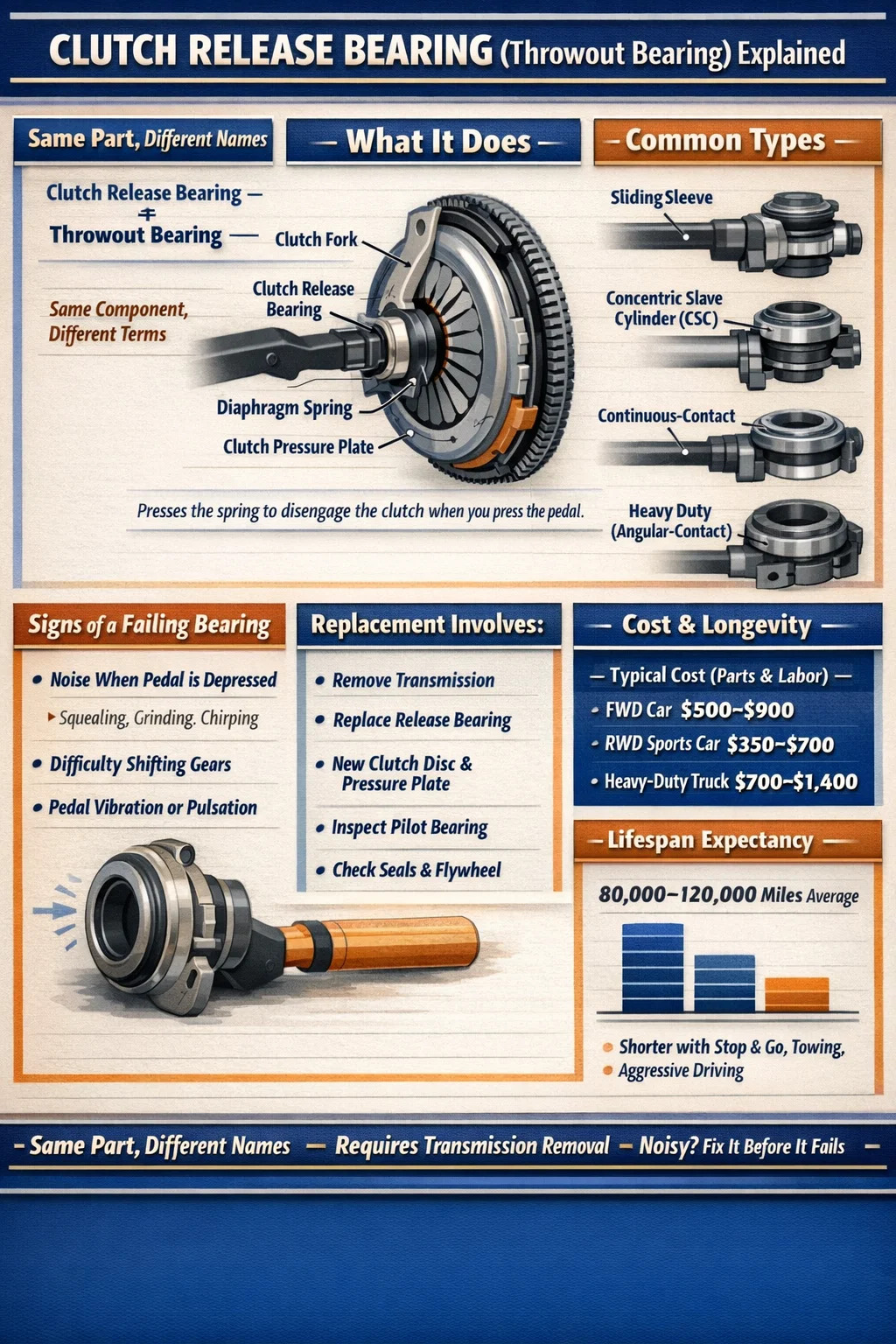
If you've ever wondered whether a clutch release bearing and a throwout bearing are different parts, the answer is simple: they are exactly the same component. "Throwout bearing" is the older, more colloquial American term, while "clutch release bearing" is the technically accurate and internationally recognized name used in engineering manuals, parts catalogs, and OEM documentation. Mechanics in North America often use both terms interchangeably, and parts suppliers list them as the same SKU. There is no functional, structural, or positional difference between the two — only a difference in naming convention.
That said, understanding what a clutch release bearing actually does, how it fails, what types exist, and when to replace it is far more valuable than sorting out nomenclature. This article covers everything from basic operation to advanced diagnostics.
What a Clutch Release Bearing Actually Does
The clutch release bearing — also called the throwout bearing — sits on the transmission input shaft sleeve, directly in front of the clutch pressure plate assembly. Its job is to act as the mechanical interface between the stationary clutch fork (or hydraulic slave cylinder) and the spinning pressure plate fingers or diaphragm spring.
When you press the clutch pedal, the fork pushes the release bearing forward along the input shaft. The bearing contacts the tips of the diaphragm spring fingers on the pressure plate. Because the pressure plate is spinning with the engine flywheel, and the fork is stationary, the bearing must rotate freely while simultaneously transmitting axial (forward) force. That combination — axial load transfer while spinning — is what defines a thrust bearing, which is exactly what a clutch release bearing is.
The pressure applied through the bearing forces the diaphragm spring to flex inward, which releases clamping force on the clutch disc. The disc can then spin freely between the pressure plate and flywheel, disconnecting engine power from the transmission input shaft. Release the pedal, and the spring snaps back, re-clamping the disc and re-engaging drive.
In a typical passenger car, the clutch pedal is depressed thousands of times per year. A driver who commutes in stop-and-go traffic might depress the clutch pedal over 30,000 times annually. The release bearing must handle that repetitive loading across temperature extremes, vibration, and varying pedal pressures.
Why the Name "Throwout Bearing" Exists
The term "throwout" comes from the action of the component: when you depress the clutch, the bearing is physically thrown out — pushed forward — toward the pressure plate. This mechanical description made intuitive sense to early automotive mechanics and became embedded in American shop-floor vocabulary throughout the 20th century.
European and Japanese manufacturers, as well as SAE technical standards, have long standardized on "clutch release bearing" because it describes the function rather than the motion. When the bearing engages the diaphragm spring, it causes the clutch to release. "Clutch release bearing" is now the dominant term in:
- OEM parts catalogs from Toyota, Volkswagen, Ford, GM, and BMW
- Aftermarket suppliers including SKF, LuK, Sachs, and Timken
- SAE and ISO technical documentation
- Service manuals from manufacturers produced after approximately 1985
In day-to-day shop talk, "throwout bearing" remains perfectly understood, especially in the United States. Neither term is wrong; they simply reflect different traditions of naming the same part.
Types of Clutch Release Bearings
Not all clutch release bearings are identical. Several distinct designs exist, each suited to different transmission configurations and actuating systems.
Sliding Sleeve Type (Most Common)
This is the standard design found on the majority of rear-wheel-drive vehicles with mechanical linkage or cable-actuated clutches. The bearing unit mounts on a plastic or metal sleeve that slides along the transmission input shaft guide tube. A clutch fork — typically a Y-shaped lever pivoting on a ball stud inside the bellhousing — pushes the sleeve and bearing forward when the pedal is depressed. Most domestic trucks and sports cars from the 1960s through today still use this arrangement.
Concentric Slave Cylinder (CSC) Type
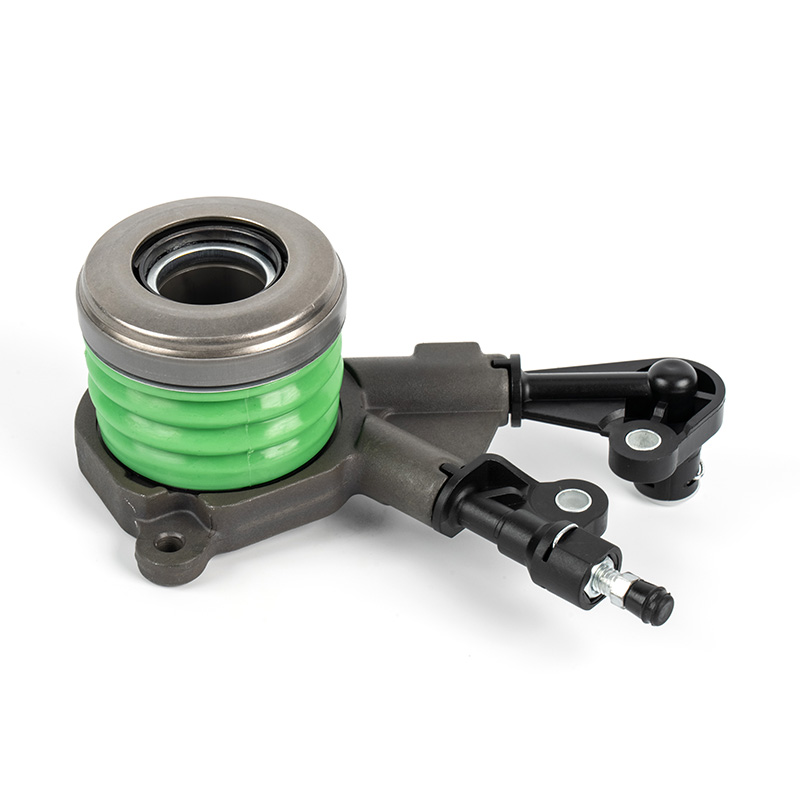
Modern front-wheel-drive vehicles and many performance cars use a concentric slave cylinder, which integrates the hydraulic actuator and release bearing into a single unit that mounts directly on the transmission housing, surrounding the input shaft. When hydraulic pressure is applied via the clutch pedal, the piston inside the CSC pushes the bearing forward against the diaphragm spring. This design eliminates the external fork, reduces the number of moving parts, and improves pedal feel. Vehicles including the Honda Civic, Volkswagen Golf (MkV onward), and Ford Focus use CSC-type release bearings. The downside: when the bearing or hydraulic seal fails, the entire CSC assembly must typically be replaced — and it requires transmission removal to access.
Continuous-Contact (Self-Centering) Type
Some manufacturers design release bearings to remain in constant light contact with the diaphragm spring fingers at all times, even when the clutch is fully engaged. This eliminates the small travel gap that exists in conventional setups and makes pedal response feel more immediate. It also means the bearing rotates continuously at engine speed, which requires higher-quality bearing materials and better sealing. LuK and Sachs offer continuous-contact bearings as OEM fitments on several European vehicles.
Angular-Contact Ball Bearing Type
Heavy-duty and commercial vehicle applications — semi-trucks, large diesel pickups, agricultural equipment — use angular-contact ball bearings or tapered roller bearings inside the release bearing housing. These provide substantially higher axial load capacity than the single-row deep-groove ball bearings used in passenger cars. A Class 8 truck clutch can require over 600 lbs of pedal force to disengage without hydraulic assistance, and the release bearing must handle that repeatedly.
| Type | Actuation Method | Typical Application | Serviceability |
|---|---|---|---|
| Sliding Sleeve | Mechanical fork / cable | RWD cars, trucks, muscle cars | Bearing replaceable separately |
| Concentric Slave Cylinder | Hydraulic (internal) | FWD cars, modern performance cars | Replace entire CSC unit |
| Continuous-Contact | Fork or hydraulic | European passenger cars | Bearing replaceable separately |
| Angular-Contact / Heavy Duty | Mechanical or air-assisted | Commercial trucks, agriculture | Bearing replaceable separately |
How to Recognize a Failing Clutch Release Bearing
A worn or failing clutch release bearing produces characteristic symptoms that are usually easy to identify once you know what to listen and feel for.
Noise When the Pedal Is Depressed
This is the most reliable indicator of a failing release bearing. A grinding, chirping, squealing, or rattling sound that appears specifically when you push the clutch pedal down — and disappears when you release it — points directly to the release bearing. The noise typically occurs because the internal bearing races have worn, the grease has dried out, or the bearing retainer has cracked. In a conventional fork-actuated system, the bearing is only loaded when the pedal is down, so the sound is tightly correlated with pedal position.
With continuous-contact designs, the bearing rotates all the time, so the noise may be present constantly and become louder or change pitch as pedal force increases.
Difficulty Engaging or Disengaging the Clutch
If the bearing has seized or collapsed partially, it may not travel smoothly along the input shaft sleeve, causing the clutch to feel stiff, uneven, or imprecise. In extreme cases, the bearing can jam and prevent full disengagement, making gear changes difficult or impossible. A completely seized bearing can also damage the diaphragm spring fingers through uneven contact, which compounds the repair cost significantly.
Clutch Pedal Vibration or Pulsation
When bearing internal components have worn unevenly, the pedal can transmit a vibration or pulsating sensation back through the fork linkage. This is different from the normal "engagement point" feedback most drivers feel. A pulsing vibration that occurs during the full pedal stroke — not just at the engagement point — is worth investigating promptly.
Visual Inspection During Clutch Service
Any time the transmission is removed for a clutch replacement, the release bearing should be inspected. Check for:
- Rough or resistant rotation when spun by hand
- Visible scoring, cracking, or discoloration on the contact face
- Worn, chipped, or missing contact pads on the fork fingers (where applicable)
- Wobble or play in the bearing assembly when pressed axially
- Oil contamination — this suggests a leaking input shaft seal that must also be addressed
Given that access requires transmission removal, virtually every professional technician replaces the release bearing any time the clutch disc and pressure plate are replaced, regardless of whether the bearing shows symptoms. The labor cost of the job far exceeds the cost of the bearing itself — typically $15 to $60 for most passenger car applications — and installing a new bearing eliminates the possibility of having to pull the transmission again 20,000 miles later for a bearing that was borderline at the time of clutch service.
Clutch Release Bearing vs. Other Clutch Components: What Gets Confused
Because the release bearing is part of a larger clutch system, its symptoms can overlap with — or be masked by — failures in adjacent components. Understanding what each part does helps isolate the actual fault.
Release Bearing vs. Pilot Bearing / Pilot Bushing
The pilot bearing or pilot bushing is a small bearing pressed into the center of the crankshaft or flywheel. It supports the forward tip of the transmission input shaft, keeping it centered and preventing flex under load. Unlike the release bearing, the pilot bearing is only under stress when the clutch is disengaged — when the input shaft is spinning at a different speed than the crankshaft. A failing pilot bearing produces noise during gear changes or when the clutch is held depressed at a stop (such as waiting at a traffic light with the transmission in first gear). If removing the bearing pressure causes the noise to stop, the problem is more likely the pilot bearing than the release bearing.
Release Bearing vs. Pressure Plate
The pressure plate provides clamping force to hold the clutch disc against the flywheel. A worn pressure plate often causes clutch slippage — where the engine RPM rises without a corresponding increase in vehicle speed, particularly under heavy throttle. A failing release bearing, by contrast, typically produces noise or engagement difficulty rather than slippage. If you notice the clutch slipping but no noise on pedal depression, the pressure plate is the more likely culprit.
Release Bearing vs. Clutch Fork
The clutch fork is the lever that translates pedal movement into axial force on the release bearing. A cracked or worn clutch fork, or a worn pivot ball stud, can cause inconsistent pedal feel, rattling noises, or in severe cases, complete loss of clutch actuation. Unlike release bearing noise, clutch fork noise is often more of a clunk or rattle at the beginning of pedal travel rather than a sustained squeal or grind mid-stroke.
Release Bearing vs. Slave Cylinder (External Type)
On hydraulically actuated systems that use an external slave cylinder (as opposed to a CSC), the slave cylinder pushes the clutch fork mechanically. A leaking or failed external slave cylinder causes a spongy or sinking clutch pedal, not mechanical noise. Bleeding the hydraulic system or inspecting for fluid leaks at the slave cylinder body will usually confirm this diagnosis quickly.
Clutch Release Bearing Replacement: What the Job Involves
There is no shortcut to replacing a clutch release bearing: the transmission must come out. On most rear-wheel-drive vehicles, this is a straightforward but labor-intensive process typically taking 3 to 6 hours for an experienced mechanic. Front-wheel-drive vehicles with transversely mounted engines and integrated transaxles can require significantly more disassembly.
General Procedure for Fork-Actuated Systems
- Safely raise and support the vehicle on jack stands or a lift.
- Disconnect the driveshaft or CV axles as required.
- Disconnect the clutch linkage, hydraulic line, or cable at the transmission.
- Support the transmission with a transmission jack and remove the crossmember.
- Remove the bellhousing bolts and slide the transmission rearward off the input shaft.
- Remove the clutch fork from the pivot ball stud and slide the release bearing off the input shaft sleeve.
- Inspect the fork, pivot ball, input shaft sleeve, and clutch components. Replace as needed.
- Install the new release bearing — most snap onto the fork fingers or clip onto the sleeve — and reinstall all components in reverse order.
CSC-Specific Considerations
Concentric slave cylinder replacement follows a similar transmission removal procedure, but once the transmission is out, the CSC simply unbolts from the transmission housing (usually 2 to 4 bolts). The hydraulic line must be disconnected and the system bled after reinstallation. Some CSC units use a quick-connect hydraulic fitting; others use a threaded banjo bolt. Always replace the hydraulic line sealing washers if they are the copper crush type.
A key caution with CSC installation: do not allow the clutch disc to hang unsupported on the transmission input shaft as the transmission is guided back into place. Use a clutch alignment tool to keep the disc centered on the flywheel, and support the transmission nose carefully to avoid bending the input shaft or damaging the CSC piston seals.
Parts to Replace at the Same Time
Since the transmission is already out, the following items should be evaluated and replaced if there is any doubt about their condition:
- Clutch disc and pressure plate (replace as a matched set)
- Pilot bearing or pilot bushing
- Rear main seal (crankshaft oil seal)
- Transmission input shaft seal
- Clutch fork (if worn or cracked)
- Pivot ball stud (if the socket is worn)
- Flywheel (resurface or replace if scored or heat-cracked)
How Long Should a Clutch Release Bearing Last
Under normal driving conditions, a quality clutch release bearing should last the life of the clutch assembly — typically 80,000 to 120,000 miles in a passenger car driven moderately. Some bearings, particularly those used in light-duty vehicles driven primarily on highways with infrequent clutch engagement, may exceed 150,000 miles without failure.
Several factors accelerate wear:
- Riding the clutch pedal — resting your foot on the pedal while driving maintains partial contact between the bearing and diaphragm spring, causing continuous low-load wear. This single habit can cut release bearing life in half.
- Frequent stop-and-go driving — urban commuting multiplies clutch engagement cycles dramatically compared to highway use.
- Towing or hauling heavy loads — increases pedal effort and the axial force the bearing must transmit.
- Aggressive or performance driving — repeated hard launches stress the entire clutch system, including the bearing.
- Poor bearing quality — budget replacement bearings using inferior steel or inadequate sealing degrade significantly faster than OEM or premium aftermarket units from SKF, Timken, or Sachs.
- Misalignment — an improperly aligned clutch disc or a bent input shaft creates side loading on the release bearing that it is not designed to handle.
Choosing a Replacement Clutch Release Bearing
The replacement parts market offers a wide range of clutch release bearings at varying price points. Understanding the differences helps make a more informed choice.
OEM vs. Aftermarket
OEM bearings come from the original equipment supplier or are rebranded equivalents. For vehicles from manufacturers that source their clutch components from LuK (now part of Schaeffler Group), Sachs, or Valeo, an OEM-equivalent bearing from those same manufacturers is typically the best choice. These bearings are manufactured to the same specifications as the original and use the same quality of steel, sealing, and grease.
Generic or no-name bearings sourced from low-cost manufacturers are often significantly cheaper — sometimes under $10 — but the quality control variance is substantial. Reports of premature failure within 10,000 to 20,000 miles are common with budget bearings, which makes the cost savings illusory given the labor required for reinstallation.
Complete Clutch Kits
Most reputable clutch suppliers — LuK, Sachs, Exedy, Valeo, ACT — sell complete clutch kits that include the clutch disc, pressure plate, and release bearing as a matched set. For most repair scenarios, buying a kit makes more practical sense than sourcing individual components, since the parts are engineered to work together and the price difference is usually modest. Kit prices for common passenger cars typically range from $80 to $350 depending on vehicle application and brand tier.
Performance Applications
Modified vehicles running upgraded clutch pressure plates — which require higher pedal force — need release bearings rated for higher axial loads. Suppliers like ACT (Advanced Clutch Technology) and South Bend Clutch offer heavy-duty release bearings alongside their performance clutch kits. Using a standard release bearing with a high-pressure performance pressure plate can cause premature bearing failure even with careful driving, because the contact force exceeds the OEM bearing's design rating.
Clutch Release Bearing Cost and Labor Estimates
Because accessing the release bearing always requires transmission removal, the part cost itself is a minor element of the total repair expense.
| Vehicle Type | Part Cost (Bearing Only) | Total Labor Hours | Estimated Total (Parts + Labor) |
|---|---|---|---|
| Compact FWD (e.g., Honda Civic, VW Golf) | $20–$90 (CSC unit) | 4–8 hours | $500–$900 |
| RWD Sports Car (e.g., Mustang, Camaro) | $15–$50 | 3–5 hours | $350–$700 |
| Half-ton Pickup (e.g., Ford F-150, RAM 1500) | $25–$70 | 4–7 hours | $450–$850 |
| Heavy-Duty Diesel Pickup (6.7L Powerstroke, Duramax) | $50–$120 | 6–10 hours | $700–$1,400 |
These estimates assume replacement of the bearing only. When the clutch disc and pressure plate are replaced at the same time — which is strongly recommended — add $100 to $400 for the additional parts depending on vehicle and brand tier. The incremental labor cost is minimal since the clutch assembly is already exposed.
Can You Drive With a Bad Clutch Release Bearing
This depends on how far the bearing has degraded. In the early stages of failure — when the only symptom is a faint chirping or squealing noise when the pedal is depressed — the vehicle is still fully functional and can be driven carefully. However, continuing to drive without addressing the problem accelerates failure and risks causing secondary damage.
If the bearing seizes completely, it may lock against the diaphragm spring fingers and prevent the clutch from disengaging at all. At that point, the vehicle cannot be shifted out of whatever gear it is currently in, and continued operation risks bending or breaking the pressure plate fingers, scoring the flywheel face, or damaging the input shaft sleeve — all of which dramatically increase repair costs.
The practical advice is: do not ignore the noise. If you hear a grinding or squealing sound that is specifically tied to clutch pedal depression, schedule the repair before the situation becomes an emergency. Driving 2,000 to 3,000 additional miles on a noisy but still-functional bearing is a different proposition than driving 15,000 miles hoping the problem resolves itself.
Summary: Clutch Release Bearing and Throwout Bearing Are the Same Part
To bring everything together clearly:
- A clutch release bearing and a throwout bearing are identical components described by different names. "Throwout bearing" is the American colloquial term; "clutch release bearing" is the standard technical designation.
- The bearing acts as a thrust interface between the stationary actuation system and the spinning pressure plate, enabling clutch disengagement.
- Multiple design types exist — sliding sleeve, concentric slave cylinder, continuous-contact, and heavy-duty — each suited to different applications.
- The primary symptom of a failing bearing is noise specifically when the clutch pedal is depressed.
- Replacement always requires transmission removal; replacing the entire clutch kit at the same time is strongly recommended.
- Quality matters — use OEM-equivalent bearings from established suppliers rather than the cheapest available option.
- Early attention to symptoms prevents secondary damage and keeps total repair costs predictable.
Related Products
Contact Us

A production enterprise specializing in the production of automobile clutch bearings and other non-standard bearings.
- Contact Information
-
 +86-575-86013311
 -
 +86-575-86013322
 -
 No. 50, Tashan 1st Road, Xinchang County, Shaoxing, Zhejiang, China

Copyrigh t© Xinchang Heyang Auto Parts Co., Ltd.. All Rights Reserved.
China auto bearing manufacturers wholesale auto bearing supplier
