 +86-13867573512
 [email protected]
 Get a quote

 English
  Español
What noise does a worn clutch release bearing make?
Author: Heyang Date: Mar 02, 2026
Content
- 1 What Does a Worn Clutch Release Bearing Actually Sound Like?
- 2 The Four Distinct Noise Stages of a Failing Clutch Release Bearing
- 3 How to Confirm the Noise Is Coming from the Clutch Release Bearing
- 4 Why Clutch Release Bearings Wear Out
- 5 Noise Comparison: Clutch Release Bearing vs. Other Common Clutch Noises
- 6 Other Symptoms That Accompany a Worn Clutch Release Bearing
- 7 How Long Can You Drive with a Noisy Clutch Release Bearing?
- 8 What the Replacement Process Involves
- 9 Preventing Early Clutch Release Bearing Failure
- 10 Concentric Slave Cylinders vs. Traditional Fork-Actuated Bearings
- 11 Summary: Key Facts to Remember
What Does a Worn Clutch Release Bearing Actually Sound Like?
A worn clutch release bearing — also called a throw-out bearing — most commonly produces a high-pitched squealing, chirping, or grinding noise that appears specifically when you press the clutch pedal and disappears when you release it. This on-off relationship with pedal movement is the clearest diagnostic clue separating a bad release bearing from other drivetrain noises. In some cases the sound shifts to a harsh, metallic grinding when the bearing has progressed beyond squealing into physical contact between metal components. If you hear a consistent growl or rumble that changes character the moment your foot touches the clutch pedal, a failing clutch release bearing is the most probable cause.
Understanding exactly what you are hearing — and when — saves you from misdiagnosing the problem as a worn pilot bearing, a failing input shaft bearing, or even transmission whine. Each of those produces noise at different times and under different conditions. The release bearing's noise signature is tied directly to pedal actuation, which makes it one of the more straightforward components to identify by ear.
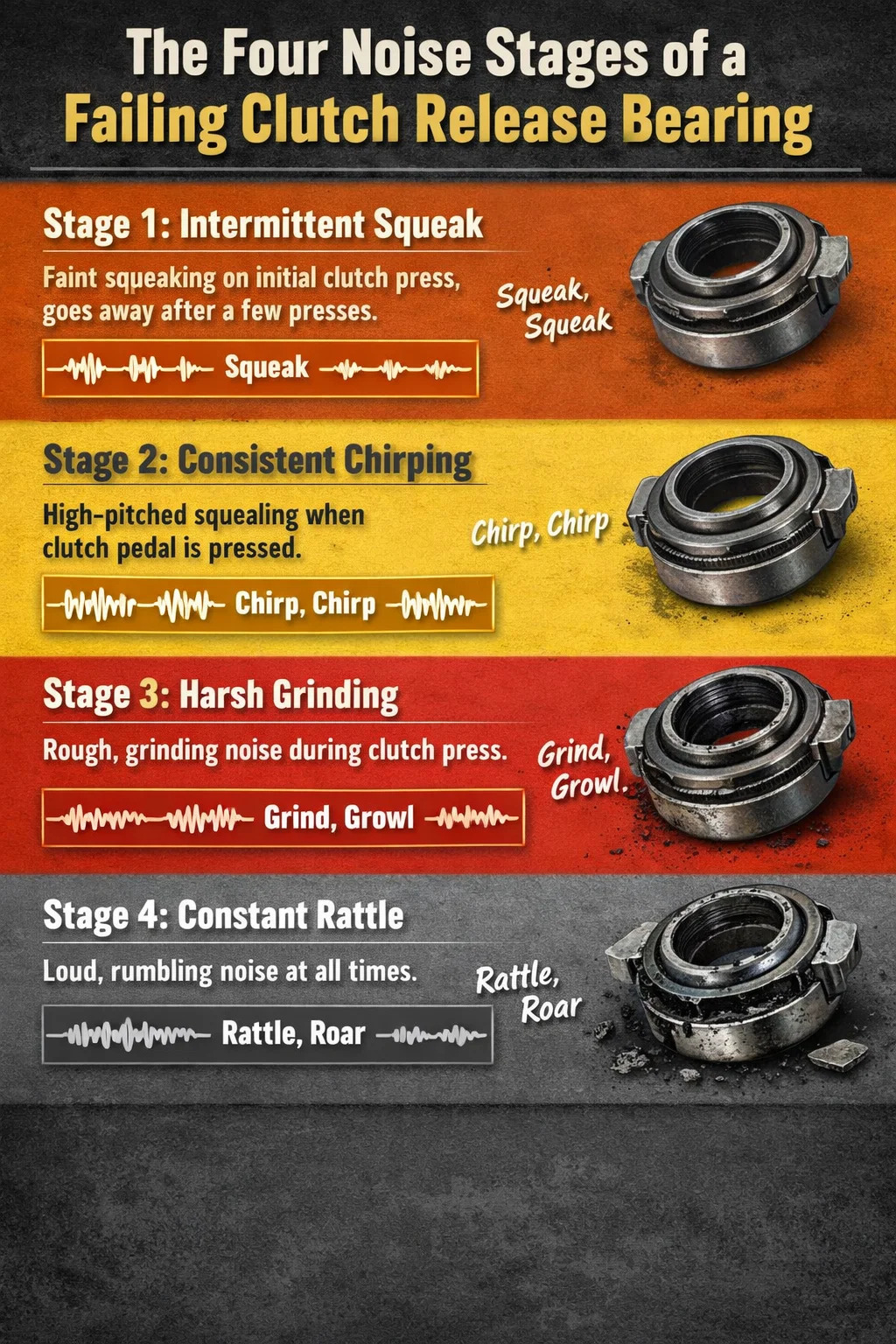
The Four Distinct Noise Stages of a Failing Clutch Release Bearing
Bearing wear rarely announces itself all at once. The deterioration follows a fairly predictable arc from subtle to catastrophic, and each stage produces a different acoustic signature. Knowing which stage you are in helps you gauge urgency.
Stage 1 — Intermittent Squeak
In the earliest stage, lubrication inside the bearing is beginning to break down or dry out. You may notice a faint squeak only on the first clutch depression after the car has been sitting overnight, and it disappears within a few presses once the bearing warms up. Many drivers dismiss this as morning condensation or a cold transmission. It is easy to ignore, but this is the cheapest and least disruptive time to address the problem — bearing replacement at this point typically involves the least collateral damage.
Stage 2 — Consistent Chirping or Squealing on Pedal Depression
This is the most commonly reported stage. The noise is now repeatable: press the clutch pedal, hear the squeal; release the pedal, the noise stops. The sound is high-frequency, sometimes described as a bird chirping or a bicycle brake squeal. Internally, the bearing's ball or roller elements are running dry, and the cage or races are beginning to show wear. At this point the bearing is functional but degrading. Most mechanics consider this stage the practical threshold for scheduling replacement, since progression to stage 3 can happen quickly once consistent noise begins.
Stage 3 — Harsh Grinding or Growling
The high-pitched squeal transitions into a lower, coarser grinding or growling sound. This indicates that the rolling elements inside the bearing have begun to fracture or that the bearing races are visibly scored. Metal-on-metal contact is occurring. At this stage there is a real risk of the bearing seizing while the clutch pedal is depressed, which can lock the clutch fork in a disengaged position and leave you stranded. Vibration transmitted through the clutch pedal itself often appears at this stage — a pulsing or roughness you feel underfoot.
Stage 4 — Continuous Noise Regardless of Pedal Position
Once the bearing has collapsed to the point where it is in near-constant contact with surrounding components, the noise becomes present whether or not the pedal is depressed. At this stage the bearing may have broken apart enough to damage the pressure plate, clutch disc, or even the flywheel. Repair costs escalate sharply here. A job that might have cost $300–$500 in parts and labor at stage 1 or 2 can exceed $1,200–$1,800 once pressure plate and flywheel resurfacing or replacement are factored in.
How to Confirm the Noise Is Coming from the Clutch Release Bearing
Because a manual transmission contains several bearings that can produce similar sounds — the input shaft bearing, the pilot bearing or bushing, and the countershaft bearings — it is worth running a few simple checks before concluding you have a bad release bearing.
The Pedal Press Test
Park the vehicle with the engine running and the transmission in neutral. Slowly depress the clutch pedal. If a squeal or grinding sound begins the moment you start pressing and stops when you fully release the pedal, the clutch release bearing is the primary suspect. The noise should track consistently with pedal movement — louder as you press further, potentially different in pitch at different pedal depths depending on how the bearing contacts the pressure plate fingers.
Distinguishing from an Input Shaft Bearing
A worn input shaft bearing produces noise with the clutch pedal fully released — meaning while driving in gear or rolling in neutral with the engine connected. Pressing the clutch pedal actually reduces or eliminates a bad input shaft bearing noise because it unloads the shaft. If your noise follows this opposite pattern — present when pedal is up, gone when pedal is down — suspect the input shaft bearing rather than the release bearing.
Distinguishing from a Pilot Bearing or Bushing
The pilot bearing (or bushing in many vehicles) sits at the center of the flywheel and supports the tip of the transmission input shaft. A worn pilot bearing typically produces noise during the clutch slip phase — when you are pulling away from a stop and the clutch is partially engaged. It may also produce a squeal or whine when the transmission is in neutral with the engine running, which is different from the pure pedal-press signature of the release bearing.
Feel for Vibration
Place your hand lightly on the gear shift while pressing the clutch pedal slowly. A failing release bearing often transmits a subtle vibration or roughness through the drivetrain that can be felt at the shifter or in some vehicles at the floorboard near the transmission tunnel. This tactile feedback, combined with the audible squeal on pedal depression, points firmly toward the release bearing.
Why Clutch Release Bearings Wear Out
Understanding the root cause matters because some failure modes are preventable, and addressing them extends the life of the next bearing.
Resting Your Foot on the Clutch Pedal
This is the single most common cause of premature release bearing failure. Even a very light resting pressure of 5–10 lbs on the clutch pedal keeps the release bearing spinning against the pressure plate diaphragm spring fingers. In normal operation the bearing is only loaded for the fraction of a second it takes to shift gears. A driver who rests their foot on the clutch pedal in traffic can add thousands of additional loaded rotations per hour, dramatically accelerating wear. Lifetime mileage for a bearing driven this way can drop from 100,000+ miles to under 30,000 miles.
Riding the Clutch on Hills
Holding a vehicle stationary on a slope by balancing clutch engagement rather than using the handbrake keeps the release bearing under continuous load and the clutch disc in a sustained slip condition. Beyond wearing the bearing, this also glazes the clutch disc and scores the flywheel face. Five minutes of hill-holding with this technique can impose the same wear as dozens of normal driving miles.
Contamination and Moisture Ingress
Modern sealed bearings are pre-lubricated and designed to operate maintenance-free, but seals degrade over time, especially in vehicles operating in wet, muddy, or dusty environments. Once moisture or grit enters the bearing, the lubricant is compromised and abrasive wear begins. Vehicles used off-road or in regions with heavy road salt application often show release bearing wear at significantly lower mileages than those driven in clean, dry conditions.
Misalignment and Improper Installation
A release bearing that is not perfectly centered on the input shaft bearing retainer, or a clutch fork that is bent or worn at its pivot point, will load the bearing unevenly. This creates a side-load condition the bearing is not designed to handle, producing rapid wear on one side of the bearing's race. The noise signature in this case is often more of a rhythmic ticking or clunking on pedal depression rather than a smooth squeal, reflecting the uneven loading.
Extended Service Life Without Replacement
Even with perfect driving technique, a release bearing is a wear item. Most manufacturers list clutch assembly service life in the range of 80,000 to 150,000 miles depending on vehicle weight, transmission type, and usage pattern. Heavy trucks and vehicles used for towing reach the lower end of that range more quickly. Many technicians recommend replacing the release bearing whenever the clutch disc is replaced, since the labor to access the bearing accounts for the majority of the total job cost.
Noise Comparison: Clutch Release Bearing vs. Other Common Clutch Noises
Not every noise from the clutch area means the release bearing is failing. The table below compares the most common noise sources and their characteristics to help narrow down the diagnosis.
| Component | Sound Type | When It Occurs | Pedal Relationship |
|---|---|---|---|
| Clutch Release Bearing | Squeal, chirp, grinding | While pedal is pressed | Noise starts on press, stops on release |
| Input Shaft Bearing | Whine, growl | Driving in gear or neutral coast | Noise reduces when pedal is pressed |
| Pilot Bearing / Bushing | Squeal, whine | During clutch slip / engagement | Noise during partial pedal release |
| Worn Clutch Disc Damper Springs | Rattle, chatter | Light throttle, low rpm | Often disappears when pedal pressed |
| Pressure Plate Diaphragm Spring | Click, tick | At specific pedal travel depth | Noise at one consistent pedal position |
| Clutch Fork Pivot Wear | Clunk, knock | On initial pedal movement | Sharp noise at start of pedal travel |
Other Symptoms That Accompany a Worn Clutch Release Bearing
Noise is the primary indicator, but a failing throw-out bearing often presents alongside other symptoms that, taken together, build a stronger case for diagnosis.
- Clutch pedal vibration: A pulsing or roughness underfoot when pressing the clutch, caused by the uneven surface of the bearing transmitting vibrations up through the clutch fork and hydraulic or cable linkage.
- Increased pedal effort: As the bearing wears and its internal drag increases, it creates additional resistance that the driver must overcome when pressing the pedal. The change is gradual and easy to miss until compared with a freshly serviced clutch.
- Difficulty engaging or disengaging gears: In advanced stages, a bearing that has started to seize or has caused the clutch fork to bind may result in incomplete clutch disengagement, making gear changes crunchy or difficult.
- Clutch slipping: While slipping is more often a worn clutch disc symptom, a seized or collapsed bearing can prevent the pressure plate from fully clamping the clutch disc, resulting in slip under load.
- Visible bearing material or metallic particles: In vehicles with an inspection cover or on the bench during a clutch replacement, technicians sometimes observe shiny metallic debris in the bellhousing consistent with bearing material breakdown.
How Long Can You Drive with a Noisy Clutch Release Bearing?
This depends entirely on which stage the bearing has reached. At stage 1 (intermittent cold squeak) or early stage 2 (consistent squeal on pedal depression but no other symptoms), many drivers continue to operate their vehicle safely for weeks or even a few months while arranging repairs. The risk is manageable as long as the bearing remains functional and the noise does not progress.
Once grinding begins (stage 3), continued driving carries meaningful risk of a breakdown. A bearing that seizes while the clutch pedal is depressed can potentially lock the clutch mechanism in the disengaged position, leaving you unable to engage a gear. In a worst case, a collapsed bearing scatters debris inside the bellhousing that scores the flywheel and pressure plate face, adding several hundred dollars to what would otherwise be a straightforward bearing and clutch disc replacement.
A practical guideline used by many experienced mechanics: if the noise is present every time you press the clutch and has been consistent for more than two weeks, book the repair promptly. If the noise has changed from a squeal to a grind even once, treat it as urgent.
What the Replacement Process Involves
Replacing a clutch release bearing requires removing the transmission to access the clutch assembly. This is the reason the job carries the labor cost it does — the bearing itself is an inexpensive component, typically priced between $20 and $80 for most passenger vehicles, but the transmission removal on a front-engine, rear-wheel-drive vehicle typically takes 3–5 hours of labor. Front-wheel-drive transaxle removal can range from 4–8 hours depending on the vehicle's layout and accessibility.
Because all of this labor is required to access the bearing, it is standard practice — and financially sensible — to replace the entire clutch kit at the same time. A clutch kit includes the disc, pressure plate, and release bearing, and sometimes a new pilot bearing or bushing. The incremental parts cost for a complete kit versus just the bearing is often $100–$300, a fraction of the additional labor that would be required for a second teardown if the clutch disc failed a year later.
Flywheel condition should also be inspected at this time. A flywheel showing heat cracks, hard spots (shiny blue-tinged circular patches), or grooves deeper than approximately 0.030 inches should be resurfaced or replaced, as a worn or scored flywheel accelerates wear on the new clutch disc and can cause clutch chatter or judder even immediately after the service.
Typical Cost Ranges by Vehicle Category
- Economy and compact cars (e.g., Honda Civic, VW Golf, Toyota Corolla): $450–$900 for a complete clutch kit including labor at an independent shop.
- Performance and sports cars (e.g., Subaru WRX, Ford Mustang, Chevrolet Camaro): $700–$1,400 depending on parts specification and transmission type.
- Light trucks and SUVs (e.g., Toyota Tacoma, Ford Ranger): $600–$1,200, with four-wheel-drive vehicles requiring additional transfer case disconnection in some cases.
- European vehicles with complex transaxle arrangements (e.g., BMW M-series, Porsche 911 with manual): $1,200–$2,500+ due to higher parts costs and extended labor times.
Preventing Early Clutch Release Bearing Failure
Good driving habits are the most effective form of maintenance for a throw-out bearing. The bearing is designed to handle the brief, cyclical loading that comes with normal gear changes. Problems arise when that loading becomes continuous or excessive.
- Keep your left foot off the clutch pedal between gear changes. Rest it on the dead pedal (footrest) to the left of the clutch pedal. Even a few pounds of resting pressure multiplied across thousands of miles adds up to significant bearing hours under load.
- Use the handbrake on hills, not the clutch. When waiting at a traffic light on an incline, engage the handbrake rather than holding position with clutch slip.
- Complete gear changes decisively. Slow, hesitant clutch engagement keeps the bearing loaded for longer per shift cycle. Smooth and reasonably prompt pedal movement extends bearing life.
- Inspect the clutch fork and pivot during any clutch service. A worn pivot ball or fork that is slightly bent causes misalignment that loads the bearing off-center. Replacing these inexpensive components at every clutch service costs little and prevents premature bearing wear.
- Address any clutch hydraulic leaks promptly. A clutch master or slave cylinder that is seeping fluid can contaminate the clutch disc and, in hydraulic release bearing systems common in modern vehicles, affect the operation and longevity of the bearing assembly itself.
Concentric Slave Cylinders vs. Traditional Fork-Actuated Bearings
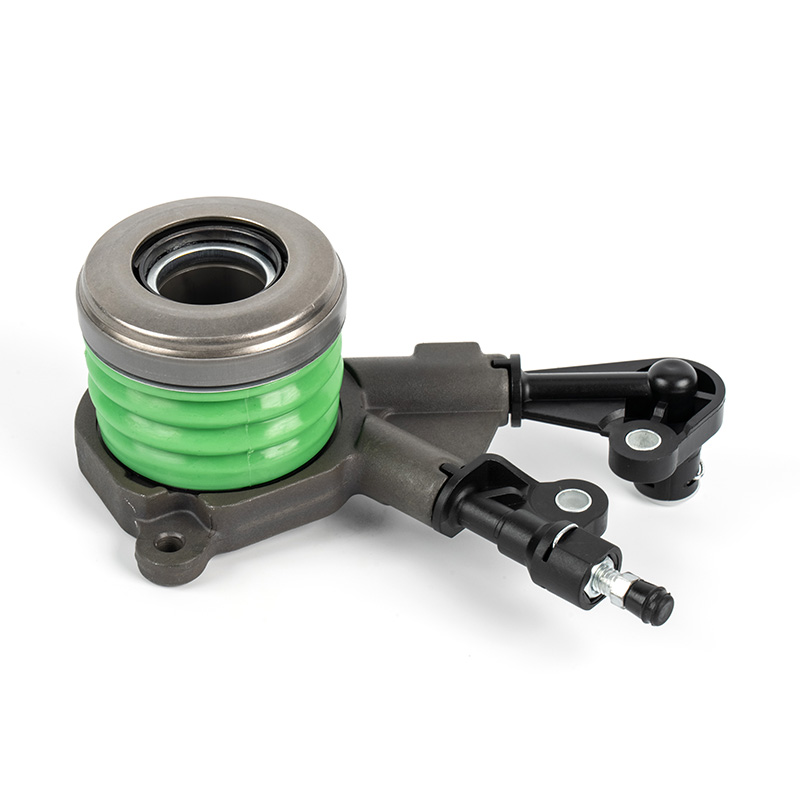
It is worth noting that many vehicles produced from the late 1990s onward use a concentric slave cylinder (CSC) instead of a traditional external slave cylinder and clutch fork arrangement. In a CSC system, the hydraulic slave cylinder is mounted inside the bellhousing directly around the input shaft, and the release bearing is integrated into the unit as a single assembly.
The noise characteristics from a failing CSC bearing are essentially identical to those of a traditional throw-out bearing — squeal or grinding on pedal depression — but the diagnosis and repair differ. A CSC cannot be replaced in isolation from its hydraulic components; the entire unit must be replaced as an assembly. Costs for a CSC unit are typically $80–$250 for the part itself, more expensive than a standalone bearing but still reasonable given the combined nature of the component. Signs of CSC failure also include clutch fluid leakage into the bellhousing, which may cause clutch disc contamination in addition to bearing noise.
Summary: Key Facts to Remember
- A worn clutch release bearing primarily produces a squeal, chirp, or grinding noise that is present when the clutch pedal is depressed and absent when it is released.
- The opposite pattern — noise when pedal is up, quiet when pressed — points toward the input shaft bearing, not the release bearing.
- Failure progresses through four stages: intermittent squeak, consistent squeal, grinding, and continuous noise regardless of pedal position.
- The most common cause of premature failure is resting a foot on the clutch pedal, which keeps the bearing spinning under load continuously.
- Replacing only the bearing while the transmission is out is poor economy — a full clutch kit costs marginally more and avoids a second teardown for the disc or pressure plate.
- Once grinding noise appears, treat the repair as urgent. Continued driving risks bearing seizure, transmission input shaft damage, and escalating repair costs.
Related Products
Contact Us

A production enterprise specializing in the production of automobile clutch bearings and other non-standard bearings.
- Contact Information
-
 +86-575-86013311
 -
 +86-575-86013322
 -
 No. 50, Tashan 1st Road, Xinchang County, Shaoxing, Zhejiang, China

Copyrigh t© Xinchang Heyang Auto Parts Co., Ltd.. All Rights Reserved.
China auto bearing manufacturers wholesale auto bearing supplier
