 +86-13867573512
 [email protected]
 Get a quote

 English
  Español
Why Does a Clutch Release Bearing Fail? Causes & Fixes
Author: Heyang Date: Mar 23, 2026
Content
- 1 Why a Clutch Release Bearing Fails: The Short Answer
- 2 The Six Root Causes of Clutch Release Bearing Failure
- 3 Symptoms: How to Recognize a Failing Clutch Release Bearing
- 4 Clutch Release Bearing Types and Their Failure Characteristics
- 5 What Happens When You Ignore a Failing Release Bearing
- 6 How to Make a New Clutch Release Bearing Last Longer
- 7 Choosing the Right Replacement Release Bearing
- 8 Frequently Asked Questions About Clutch Release Bearing Failure
- 8.1 Can a clutch release bearing failure damage the transmission?
- 8.2 Is it possible to replace just the release bearing without replacing the full clutch?
- 8.3 Does a bad release bearing make noise all the time or only when the pedal is depressed?
- 8.4 How much does it cost to replace a clutch release bearing?
- 8.5 Can a clutch release bearing be re-greased and reused?
- 8.6 What is the difference between a throw-out bearing and a release bearing?
Why a Clutch Release Bearing Fails: The Short Answer
A clutch release bearing — also called a throw-out bearing — fails primarily because of prolonged contact friction, inadequate lubrication, contamination from oil or clutch dust, and the cumulative mechanical stress of repeated engagement and disengagement cycles. In most passenger vehicles, a clutch release bearing is designed to last between 80,000 and 150,000 miles, but real-world driving habits, fluid leaks, and poor installation practices can reduce that lifespan dramatically — sometimes to under 40,000 miles.
The bearing itself sits between the clutch fork (or hydraulic actuator) and the diaphragm spring fingers of the pressure plate. Every time the driver depresses the clutch pedal, the release bearing slides forward on the transmission input shaft sleeve and presses against the spinning pressure plate fingers. That repeated contact — even for a fraction of a second each time — adds up to enormous wear over the bearing's lifespan. When any one of several conditions degrades the bearing's ability to handle that load, failure follows.
Understanding exactly what causes that degradation is not just academic. It directly informs how to choose a replacement release bearing, how to install it correctly, and what driving habits to change to prevent the same failure from recurring.
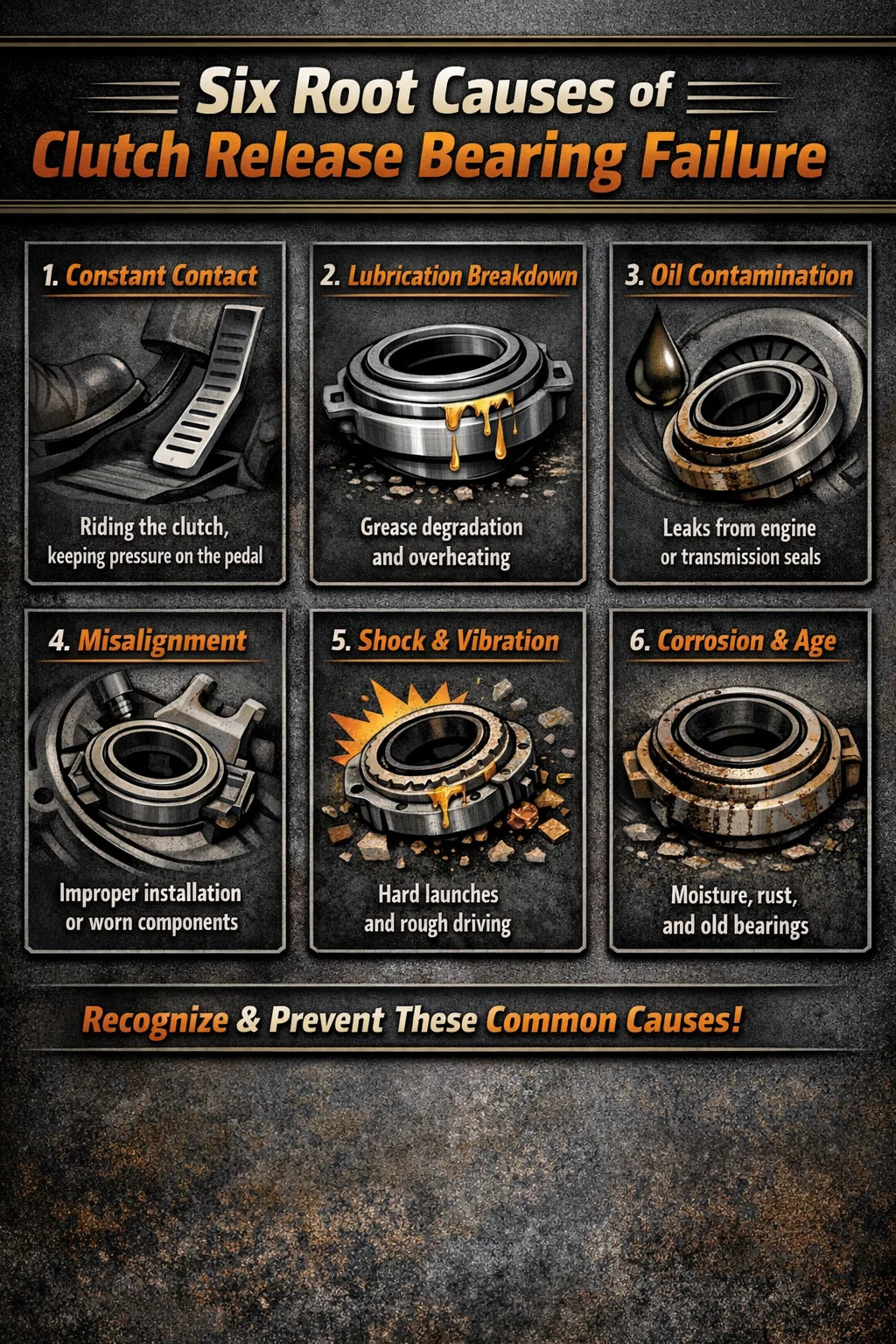
The Six Root Causes of Clutch Release Bearing Failure
1. Continuous Contact with the Diaphragm Spring
This is the single most common cause of premature wear in vehicles with cable-operated or mechanical clutch linkages. Drivers who rest their left foot lightly on the clutch pedal — a habit sometimes called "riding the clutch" — keep the throw-out bearing in constant, partial contact with the spinning diaphragm spring fingers. Even a few pounds of pedal pressure is enough to push the bearing into the rotating spring, generating heat and friction that destroy the bearing's grease, cage, and raceway surfaces.
In hydraulically actuated systems (where the bearing is a concentric slave cylinder bearing or CSC), this issue is somewhat mitigated by design, but even hydraulic systems can have a small amount of residual pressure if the master cylinder seals are weak, maintaining slight contact.
Studies on clutch component wear have shown that a driver who habitually rests their foot on the clutch pedal can reduce bearing service life by 30–50% compared to a driver with clean pedal technique.
2. Lubrication Breakdown and Grease Degradation
The clutch release bearing is a pre-greased, sealed unit in virtually all modern applications. The grease inside is typically a lithium-complex or polyurea-based grease rated for high-temperature operation — the clutch environment regularly reaches temperatures between 150°C and 250°C (300–480°F) during normal driving. Under severe conditions, such as repeated hill starts, heavy towing, or track use, temperatures can spike well above 300°C.
At those extreme temperatures, the grease breaks down chemically. The base oil separates from the thickener, viscosity drops, and the lubricating film between the rolling elements and raceways becomes insufficient. Metal-to-metal contact begins. Once that happens, the bearing generates its own heat through friction, accelerating the degradation in a self-reinforcing cycle. The bearing seizes or spalls within a relatively short time after initial grease breakdown.
Externally applied grease is actually a hazard rather than a benefit in most cases. If a technician applies grease to the input shaft sleeve where the bearing slides, excess grease migrates into the clutch disc, contaminating the friction material and causing clutch slip. The correct approach is to apply a very thin film of high-temperature grease to the sliding surface only — not to the bearing face or the friction disc area.
3. Contamination from Oil Leaks
The clutch housing is a sealed environment, but two primary oil leak sources can introduce contamination: the rear main seal (engine side) and the transmission input shaft seal (gearbox side). Both seals face the clutch disc and the release bearing. When either seal weeps oil — even a small amount — the oil migrates across the flywheel, clutch disc, pressure plate, and eventually reaches the release bearing.
Oil contamination damages the release bearing in two ways. First, the oil acts as a solvent, washing the grease out of the sealed bearing. Second, oil saturated with combustion byproducts or gear oil additives reacts chemically with the grease and the bearing's steel components, causing corrosion pitting on the raceways. Pitted raceways generate the characteristic rumbling or growling noise that mechanics associate with a worn throw-out bearing.
The critical repair principle here: if you replace a clutch release bearing on a vehicle with a known oil leak, the new bearing will fail prematurely unless the leak source is fixed first. Many repeat failures traced to "defective" bearings are actually the result of an unfixed rear main seal.
4. Misalignment and Installation Errors
A release bearing must sit perfectly parallel to the pressure plate's diaphragm spring fingers. Any angular misalignment — even as little as 0.5–1.0 mm of off-center contact — creates an uneven load distribution across the bearing's rolling elements. Some balls or rollers carry a disproportionate share of the load, leading to localized fatigue, spalling, and eventual bearing collapse.
Misalignment has several root causes:
- A worn or bent clutch fork that no longer pushes the bearing squarely
- A worn pilot bearing (the small bearing at the center of the flywheel or crankshaft) that allows the transmission input shaft to wander
- A bent or incorrectly torqued pressure plate bolts leading to a cocked pressure plate
- Failure to use an alignment tool when installing the clutch disc, leaving the disc off-center and pulling the diaphragm spring out of flat
- A damaged or worn transmission bell housing that no longer centers the gearbox to the engine block
Professional clutch installers always check bell housing runout with a dial indicator before installing a new clutch kit. Bell housing runout should typically be within 0.005 inches (0.127 mm) of true. If it exceeds that, the source of misalignment must be corrected before the new components are installed.
5. Vibration, Shock Loading, and Aggressive Driving
High-performance driving, track use, and frequent hard launches impose shock loads on the clutch release bearing that far exceed what the component was designed for in standard road use. Each hard launch event sends a sharp spike of force through the bearing as the clutch engages. Over time, these shock loads cause subsurface fatigue in the bearing's raceways — a failure mode known as spalling, where flakes of hardened steel break free from the raceway surface.
Vehicles driven on rough roads — particularly trucks and SUVs operating off-road — can experience additional vibration that resonates through the drivetrain and into the clutch assembly. While the bearing is somewhat protected by the clutch disc's torsional springs, sustained vibration gradually fatigues the bearing cage, particularly in older designs using stamped steel cages rather than machined or polymer cages.
For performance applications, upgrading to a heavy-duty release bearing with a forged or machined steel cage, larger ball elements, and higher-temperature grease is a practical necessity rather than an optional upgrade.
6. Age, Corrosion, and Moisture Ingress
In vehicles that see significant seasonal temperature swings, moisture can condense inside the clutch housing during cold weather. That moisture attacks the outer surface of the release bearing and, over time, penetrates the bearing seals, mixing with the internal grease and causing oxidation of the steel raceways. Corrosion pitting accelerates rolling-element fatigue dramatically — a bearing with even slight raceway pitting has a service life that may be 60–70% shorter than an unpitted equivalent.
Vehicles stored for extended periods (seasonal vehicles, classics, project cars) are particularly vulnerable. After a long storage period without operation, the grease in the bearing can congeal or separate, leaving the raceways unprotected when the vehicle returns to service. In these cases, replacing the clutch release bearing as a matter of course during any long-storage reconditioning service is sound preventive maintenance rather than unnecessary cost.
Symptoms: How to Recognize a Failing Clutch Release Bearing
Catching release bearing failure early can prevent the damage from cascading to the pressure plate and clutch disc — components that cost substantially more to replace. The symptoms follow a fairly predictable progression:
| Stage | Symptom | When It Occurs | Urgency |
|---|---|---|---|
| Early | Faint chirping or squealing | Only when pedal is depressed | Monitor; plan replacement |
| Moderate | Persistent grinding or rumbling | Throughout pedal travel | Replace soon |
| Advanced | Vibration felt through pedal | During engagement and disengagement | Replace immediately |
| Critical | Clutch pedal goes to floor / no disengagement | Complete failure; bearing has seized or disintegrated | Vehicle undriveable |
A critical diagnostic distinction: noise that occurs only when the clutch pedal is depressed and disappears when the pedal is released almost always points to the throw-out bearing. Noise that occurs when the pedal is released and disappears when depressed typically indicates a worn pilot bearing. Getting this distinction right avoids misdiagnosis and an unnecessary full clutch replacement.
Some drivers also notice the clutch engagement point shifting — typically moving higher up the pedal travel as the bearing wears. This happens because the worn bearing no longer pushes the diaphragm spring fingers to their designed release point, requiring extra pedal travel to fully disengage the clutch.
Clutch Release Bearing Types and Their Failure Characteristics
Not all release bearings are constructed the same way, and different designs have distinct failure modes that are worth understanding when selecting a replacement.
Standard Angular Contact Bearing
The most common type in passenger cars. It uses a single row of balls in angular contact arrangement, able to handle both radial and axial (thrust) loads. The axial load capacity is particularly important because releasing the clutch generates a significant thrust load as the bearing pushes against the diaphragm spring. Standard angular contact bearings fail predominantly through grease breakdown, raceway pitting, and cage fatigue.
Concentric Slave Cylinder (CSC) Bearing
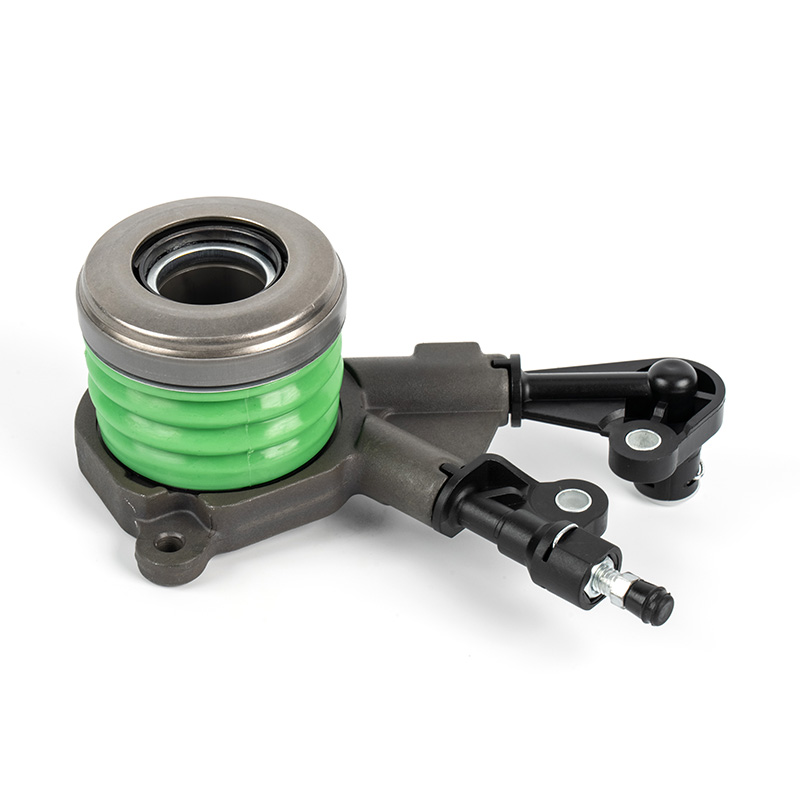
Found in many modern vehicles with hydraulic clutch actuation, the concentric slave cylinder integrates the release bearing directly into a hydraulic piston assembly mounted on the transmission input shaft housing. The bearing is always in contact with the diaphragm spring, maintained by hydraulic pressure rather than a mechanical fork. This design reduces the shock loads from fork engagement but introduces a unique failure mode: hydraulic seal failure within the CSC itself, causing fluid leaks that contaminate the bearing and clutch disc. Because the CSC bearing cannot be replaced separately in most designs, the entire assembly must be replaced — at a typical cost of $80–$200 for the part alone, significantly more than a conventional release bearing.
Self-Centering Release Bearing
Used in applications where slight misalignment is expected or difficult to fully eliminate — common in commercial trucks, heavy equipment, and some agricultural machinery. The bearing has a floating carrier that allows it to self-align to the diaphragm spring's center. This design is considerably more tolerant of minor misalignment but still fails from contamination and grease degradation, often at higher overall mileages than standard bearings because the self-centering action prevents the localized overload that misalignment causes in fixed-carrier designs.
Solid Contact Face Bearing
Older vehicles sometimes used a carbon contact face bearing rather than a rolling-element bearing. The carbon graphite face pressed directly against the spinning diaphragm spring fingers and wore gradually over time. These bearings fail through simple mechanical wear of the carbon face — usually generating a fine black dust inside the bell housing — and through cracking of the carbon due to thermal shock. Carbon face bearings are rarely seen in new production vehicles but remain common in vintage and classic car applications.
What Happens When You Ignore a Failing Release Bearing
Continuing to drive with a worn clutch release bearing is not just a noise nuisance — it creates a cascade of secondary damage that escalates repair costs significantly. The sequence of events is predictable:
- The worn bearing begins to contact the diaphragm spring unevenly, causing the spring fingers to wear at different rates. Uneven spring finger wear changes the clutch engagement feel and progressively reduces clamping force on the clutch disc.
- As the bearing continues to degrade, its cage fractures. Fragments of the cage, balls, or raceways scatter inside the bell housing. These fragments can wedge between the clutch disc and flywheel or pressure plate, scoring the friction surfaces and the flywheel face.
- A flywheel that has been scored or thermally damaged from contact with bearing debris must either be resurfaced (if within manufacturer tolerances) or replaced. Flywheel replacement on many vehicles costs $200–$500 for the part plus the labor to remove and reinstall the transmission — which is already necessary for clutch work, but the flywheel replacement adds time and parts cost.
- In extreme cases, bearing seizure locks the release mechanism in the disengaged position. The vehicle cannot be driven, and the transmission must be removed to free the seized assembly.
The cost difference between replacing only the release bearing (typically $150–$400 in labor plus $20–$80 for the bearing) and replacing the full clutch kit including flywheel resurfacing (typically $800–$1,800 total) illustrates why early diagnosis and prompt replacement is economically sound. The labor cost to access the clutch is the same in either scenario — the transmission must come out — so the only variable is parts cost.
How to Make a New Clutch Release Bearing Last Longer
Prevention is straightforward once the root causes are understood. The following practices apply both to extending the life of an original bearing and to protecting a freshly installed replacement:
Eliminate the Foot-on-Pedal Habit
When not actively shifting, keep the left foot on the dead pedal (the floor rest to the left of the clutch) rather than on the clutch pedal. This is the single most impactful behavioral change for extending release bearing life. Drivers who transition from automatic to manual transmission vehicles often develop the foot-resting habit from their left foot having nothing to do — breaking this habit should be the first priority.
Fix Oil Leaks Before Replacing the Bearing
Always inspect the rear main seal and transmission input shaft seal before or during clutch work. Both seals are accessible with the transmission removed — the same step required to reach the release bearing — so replacing worn seals at the same time adds minimal extra cost while protecting the new bearing from contamination.
Replace the Full Clutch Kit as a Set
Since the labor cost to access the clutch is fixed, replacing only the release bearing while leaving an aged clutch disc and pressure plate in place is rarely wise. A clutch disc that has worn to within a few millimeters of its wear limit will need replacement within another 20,000–30,000 miles, requiring the same expensive disassembly. Most professional mechanics and OEM service manuals recommend replacing the clutch disc, pressure plate, release bearing, and pilot bearing as a complete set to maximize the interval between clutch services.
Use an Alignment Tool During Installation
A clutch disc alignment tool — a plastic or metal dummy input shaft that fits through the clutch disc hub and into the pilot bearing — is an inexpensive tool (typically under $15) that ensures the disc is perfectly centered before the pressure plate is torqued down. Skipping this step is one of the most common installation errors that leads to premature release bearing failure from misalignment.
Lubricate the Input Shaft Sleeve Correctly
Apply a thin, even film of high-temperature bearing grease to the transmission input shaft sleeve where the release bearing slides. The film should be so thin it is almost invisible — a common error is applying too much grease, which then flings outward and contaminates the clutch disc. Never apply grease to the bearing's contact face or to the diaphragm spring fingers.
Check Bell Housing Runout
If the vehicle has a history of premature clutch component failures — particularly if this is a second or third release bearing replacement — checking the bell housing bore runout with a dial indicator is a worthwhile diagnostic step. Runout exceeding the manufacturer's specification (commonly 0.005 to 0.010 inches) points to a bent or damaged bell housing that must be corrected to prevent recurrence.
Choosing the Right Replacement Release Bearing
The replacement clutch release bearing market ranges from economy-grade parts sourced from low-cost manufacturing facilities to OEM-equivalent and performance-grade bearings with significantly higher build quality. The differences are meaningful:
| Grade | Construction | Expected Life (Normal Driving) | Typical Price Range |
|---|---|---|---|
| Economy | Stamped steel cage, basic grease | 40,000–70,000 miles | $10–$25 |
| OEM-Equivalent | Machined or polymer cage, high-temp grease | 80,000–120,000 miles | $25–$65 |
| Performance / Heavy-Duty | Forged steel cage, larger balls, extreme-temp grease | 100,000+ miles under normal conditions; rated for track use | $60–$150 |
For standard daily drivers under normal use, an OEM-equivalent bearing from a reputable supplier (SKF, FAG, LUK, Sachs, NSK, JTEKT) is the practical choice. The difference in price between a $15 economy bearing and a $45 OEM-equivalent bearing is negligible compared to the $400–$800 labor cost to access the clutch — so using the higher-quality part makes clear economic sense.
For performance vehicles, towing applications, or any vehicle where clutch temperatures regularly run high, specifying a heavy-duty release bearing rated for higher thermal and mechanical loads is a worthwhile investment. Several specialty clutch manufacturers offer complete kits pairing a performance pressure plate and clutch disc with a matched heavy-duty throw-out bearing, which ensures all components are designed to work together at the same performance level.
Frequently Asked Questions About Clutch Release Bearing Failure
Can a clutch release bearing failure damage the transmission?
Rarely directly, but yes — in catastrophic failure scenarios where bearing fragments scatter inside the bell housing, debris can score the transmission input shaft or damage the front bearing retainer. In most cases, the damage is contained to the clutch components themselves (disc, pressure plate, flywheel). However, operating a vehicle with a known failing release bearing increases the risk of escalating damage, so prompt replacement is always the safer course.
Is it possible to replace just the release bearing without replacing the full clutch?
Technically yes, but practically it depends on the clutch disc's remaining service life. If the clutch disc still has substantial friction material remaining and the pressure plate shows no signs of wear, replacing only the release bearing is defensible. In most real-world cases, though, the clutch disc and pressure plate will have accumulated significant wear by the time the bearing fails, making a full kit replacement the economically wiser choice given the fixed labor cost.
Does a bad release bearing make noise all the time or only when the pedal is depressed?
In a cable or mechanical linkage system, the release bearing is only in contact with the diaphragm spring when the pedal is depressed, so noise typically occurs only when the pedal is pressed. In hydraulic systems with a concentric slave cylinder, the bearing is in constant light contact, so noise may be present at all times. Either way, the noise changes character — typically getting louder or more grinding — when pedal load increases.
How much does it cost to replace a clutch release bearing?
The bearing itself costs $20–$150 depending on vehicle and bearing grade. Labor typically runs $400–$800 at independent shops and somewhat more at dealerships, because the transmission must be removed. Total cost for bearing-only replacement: roughly $450–$950. A full clutch kit including disc, pressure plate, release bearing, and pilot bearing adds $150–$400 in parts, bringing the total to approximately $600–$1,400 for a complete clutch job on most passenger vehicles.
Can a clutch release bearing be re-greased and reused?
No. Modern release bearings are sealed, pre-greased units that are not serviceable. Once the internal grease has degraded and the raceways have begun to pit or corrode, the bearing must be replaced. Even if a bearing appears to spin freely by hand, internal damage to the raceway surfaces will cause failure under the higher loads of normal operation. Re-greasing the exterior of the bearing housing does not help and may introduce contamination.
What is the difference between a throw-out bearing and a release bearing?
"Throw-out bearing" and "clutch release bearing" refer to exactly the same component. "Throw-out bearing" is the colloquial American English term widely used in shops and among DIY mechanics. "Clutch release bearing" is the more formal engineering designation and the term used in most OEM service manuals and parts catalogs. Both terms describe the bearing assembly that actuates the pressure plate's diaphragm spring when the clutch pedal is pressed.
Related Products
Contact Us

A production enterprise specializing in the production of automobile clutch bearings and other non-standard bearings.
- Contact Information
-
 +86-575-86013311
 -
 +86-575-86013322
 -
 No. 50, Tashan 1st Road, Xinchang County, Shaoxing, Zhejiang, China

Copyrigh t© Xinchang Heyang Auto Parts Co., Ltd.. All Rights Reserved.
China auto bearing manufacturers wholesale auto bearing supplier
