 +86-13867573512
 [email protected]
 Get a quote

 English
  Español
What Do Bad Bearings Sound Like? Signs & Sounds Explained
Author: Heyang Date: Mar 30, 2026
Content
- 1 The Core Sounds of a Failing Bearing
- 2 How Bearing Sounds Differ by Application
- 3 Why Bearings Make Noise: The Root Causes
- 4 Diagnosing Which Bearing Is Bad
- 5 Sounds That Are Often Confused With Bearing Noise
- 6 How Long Can You Drive on a Bad Bearing?
- 7 Bearing Replacement Cost Expectations
- 8 Preventing Bearing Failure Before It Starts
Bad bearings most commonly produce a grinding, rumbling, or humming noise that changes in pitch or intensity with speed. In wheel bearings, this sound typically gets louder when the vehicle turns in one direction. In industrial or electric motor bearings, you may hear squealing, clicking, or a rhythmic knocking that wasn't there before. These sounds are not random — each one tells a specific story about how and where the bearing is failing.
Catching bearing noise early is the difference between a $30 part and a $3,000 repair. A bearing that starts as a faint hum can progress to complete seizure within weeks, causing secondary damage to spindles, hubs, shafts, and housings. The sounds described in this guide apply to automotive wheel bearings, engine bearings, industrial machinery bearings, and appliance bearings alike — the physics of failure is the same across all of them.
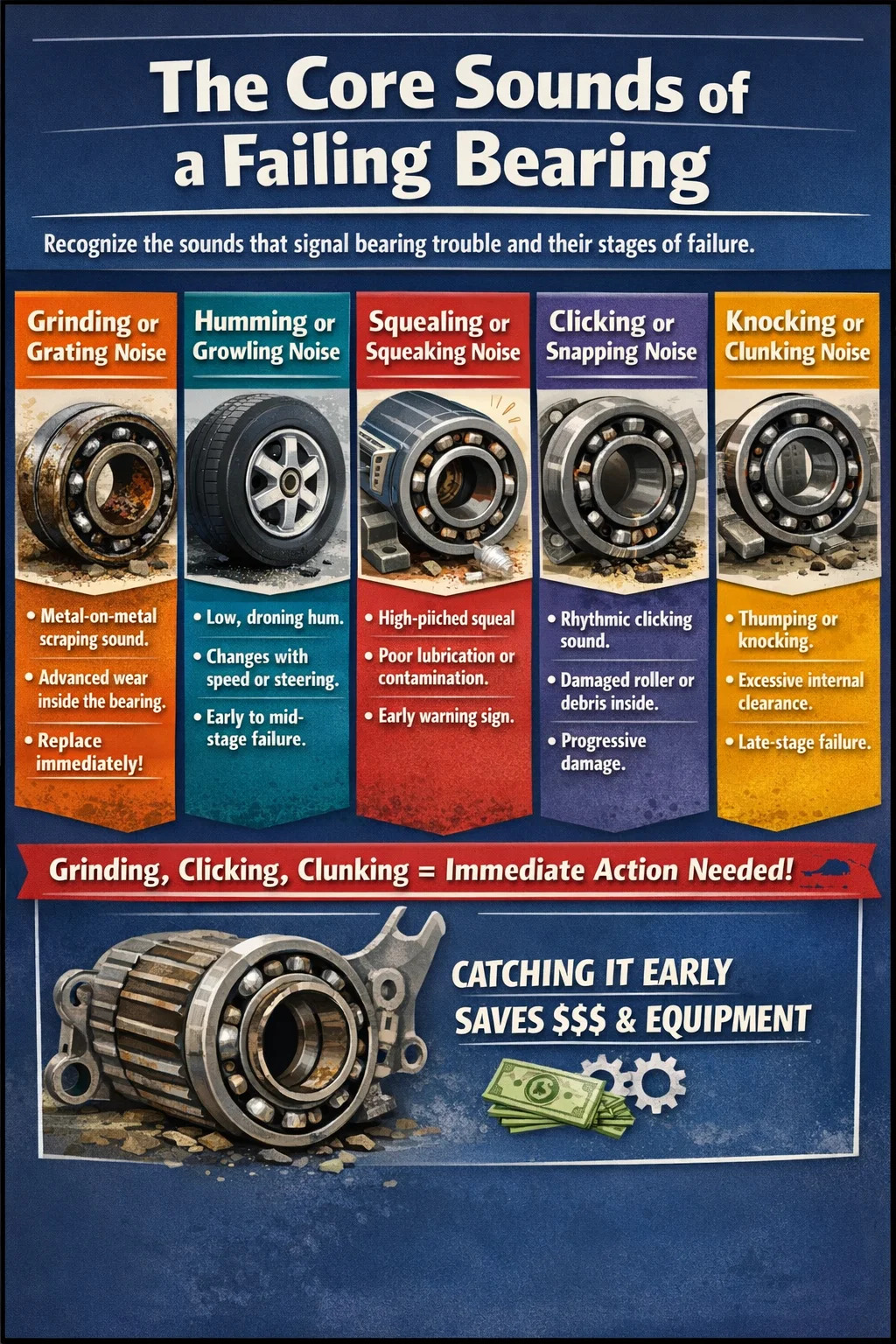
The Core Sounds of a Failing Bearing
Bearings fail in stages, and each stage has an associated sound signature. Understanding these sounds allows you to estimate how much life remains in the bearing and how urgently it needs attention.
Grinding or Grating Noise
This is the most recognized symptom of a badly worn bearing. Grinding occurs when the rolling elements — balls or rollers — have lost their smooth surface due to wear, corrosion, or contamination. Metal is essentially scraping against metal inside the race. In a wheel bearing, this sound is constant while driving and becomes louder as speed increases. If you hear a grinding sound from a wheel that gets noticeably worse above 30 mph, the bearing is in advanced failure. Do not delay replacement at this stage.
Humming or Growling Noise
A low-frequency humming or growling is typically an early-to-mid-stage bearing sound. It resembles the sound of driving over rough pavement even when the road is smooth. For wheel bearings, the hum often changes when you shift your weight slightly — such as when changing lanes or taking a sweeping highway curve. If the humming increases when you steer slightly left and decreases when you steer right, the right-side bearing is the suspect. This directional quality is one of the most reliable diagnostic clues for wheel bearing noise specifically.
Squealing or Squeaking Noise
Squealing in a bearing usually points to one of two problems: inadequate lubrication or the early stages of surface fatigue on the races. A dry bearing — one where the grease has dried out, been washed away, or never properly applied — will squeal under load. This is often the first audible warning sign, appearing before any grinding develops. In electric motors and fans, a squealing bearing might be mistaken for a belt issue, but the sound persists even after belts are checked. Squealing bearings in appliances like washing machines often signal that the seal has failed and water has contaminated the grease.
Clicking or Snapping Noise
Clicking sounds from a bearing are often associated with CV joint bearings in front-wheel-drive vehicles, but they also occur in other bearing types when a rolling element has sustained a flat spot or when debris has entered the bearing assembly. The click tends to be rhythmic, repeating at a rate proportional to the rotational speed of the shaft or wheel. A clicking noise from a wheel bearing that becomes faster as you accelerate is a reliable indicator of physical damage to a bearing surface.
Knocking or Clunking Noise
Knocking from a bearing indicates excessive internal clearance — the rolling elements have too much room to move, causing them to strike the races with force. This often happens when bearing preload has been lost due to wear or when the bearing has been improperly installed. In rear axle bearings and differential bearings, a knocking sound during acceleration or deceleration is a common symptom. This is late-stage bearing failure and represents a real safety concern, particularly on the rear axle where bearing collapse can lead to wheel separation.
How Bearing Sounds Differ by Application
The same fundamental failure modes produce slightly different audible signatures depending on what the bearing is doing and what surrounds it. Context matters when diagnosing bearing noise.
| Application | Common Bearing Sound | Key Trigger | Urgency Level |
|---|---|---|---|
| Wheel bearing (car) | Humming, grinding, growling | Speed, steering input | High — safety critical |
| Engine bearing | Knocking (rod knock) | Engine load, RPM | Extremely high — stop driving |
| Electric motor bearing | Squealing, humming | Load variation, startup | Medium — monitor closely |
| Washing machine bearing | Rumbling, roaring on spin | High-speed spin cycle | Medium — machine at risk |
| Industrial machinery bearing | Clicking, grinding, vibration | Load, temperature | High — production risk |
| Skateboard / inline skate bearing | Rough rolling, rattling | High speed, debris | Low — replace when convenient |
Wheel Bearings
Wheel bearings support the entire weight of a vehicle while allowing the wheel to rotate freely. They are constantly exposed to road grime, water, and the lateral forces of cornering. A failing wheel bearing almost always produces a directional hum or growl that increases with vehicle speed. The signature test is a gentle lane-change maneuver at highway speed: if the noise changes when you shift the vehicle's weight to the left or right, you've identified the bearing. Studies of wheel bearing failures show that contamination from water intrusion accounts for roughly 55% of premature bearing failures, particularly on vehicles driven in wet climates or frequently washed with high-pressure hoses pointed at the hub.
Engine Rod and Main Bearings
Engine bearings are plain (sleeve) bearings — not rolling element bearings — but they fail in audible ways that are immediately recognizable. A worn rod bearing produces a sharp, rhythmic knock that increases with engine RPM and is most prominent under load. Main bearings produce a deeper, heavier knock that is more consistent and less speed-dependent. Rod knock at idle that disappears as RPM climbs is a warning sign; rod knock that is present at all RPMs means the bearing clearance has exceeded safe limits and engine failure is imminent. Oil starvation is the leading cause, which is why regular oil changes matter so much — dirty, depleted oil cannot maintain the film thickness needed to keep engine bearings from metal-to-metal contact.
Washing Machine Drum Bearings
When a washing machine bearing fails, the drum begins to sound like a jet engine during the spin cycle. A loud roaring or rumbling noise — particularly in front-loading machines — is the telltale sign. The drum may also wobble visibly, and the machine might vibrate across the floor. Water is almost always the culprit: the drum seal fails over time, allowing water and detergent to contaminate the bearing. Replacing the bearing in a front-loader typically requires nearly complete disassembly of the machine, which is why many repair technicians recommend evaluating whether replacement of the entire machine is more cost-effective once the bearing has failed.
Industrial and Electric Motor Bearings
In industrial settings, bearing noise is taken seriously as a maintenance trigger. Motors running failed bearings overheat, consume more power, and eventually seize — causing unplanned downtime that costs far more than a scheduled replacement. Common sounds include high-pitched squealing from lubrication failure, cyclic clicking from flaking (spalling) of the race surface, and a broad-spectrum noise increase that vibration analysis tools can detect well before the human ear can. Many industrial facilities use handheld stethoscopes or ultrasonic sensors placed directly on motor housings to listen for bearing noise without shutting the equipment down.
Why Bearings Make Noise: The Root Causes
Understanding what causes bearing noise helps you not only diagnose the current failure but also prevent the next one. Bearings don't make noise for no reason — every sound has a physical cause.
Loss of Lubrication
Grease or oil creates a thin film between the bearing's moving components. When this film breaks down — from heat, age, contamination, or water washout — metal contacts metal and friction increases dramatically. A bearing running without adequate lubrication can fail within minutes under load, whereas a properly lubricated bearing of the same type might last a decade. Squealing is usually the first sound of lubrication failure; grinding follows quickly as surface damage accumulates.
Contamination
Dirt, dust, metal particles, and water are the enemies of bearings. Even microscopic abrasive particles that enter the bearing housing will score the rolling surfaces and races over time, producing a gritty grinding or rumbling noise. Water contamination is particularly damaging because it causes corrosion pitting on the precision-ground surfaces inside the bearing. Research from bearing manufacturers has shown that contamination accounts for approximately 14% of all premature bearing failures in industrial environments, though this number climbs significantly in outdoor or wet applications.
Overloading and Misalignment
Bearings are rated for specific load capacities. Running a bearing beyond its dynamic or static load rating accelerates wear and deformation of the rolling elements and races. Misalignment — where the shaft is not centered within the bearing — creates uneven stress on one side of the race. Both conditions produce noise: overloading typically results in a general rumbling or grinding, while misalignment often causes a repeating rhythmic noise as the same damaged contact point passes through the load zone with each rotation.
Spalling and Fatigue Failure
Even correctly installed and lubricated bearings have a finite service life. Repeated stress cycling eventually causes micro-cracks to form beneath the surface of the race or rolling elements. These cracks propagate until material breaks away — a process called spalling. Spalled bearings produce a distinctive, irregular clicking or rattling sound as the broken fragments circulate through the bearing and impact other surfaces. This is end-of-life fatigue failure, and it is normal after a bearing has operated for many millions of rotations. Replacing the bearing at the first sound of spalling prevents the fragments from damaging the housing or shaft.
Improper Installation
A new bearing can be destroyed during installation. Pressing a bearing on incorrectly — applying force to the wrong race, using a hammer directly on the bearing, or installing it cocked at an angle — damages the internal geometry immediately. A freshly installed bearing that makes noise right away is almost certainly a damaged or incorrectly installed bearing. Using the correct bearing press tools and applying force only through the correct race is essential; a $200 tool pays for itself the first time it prevents destroying a $150 wheel bearing hub assembly.
Diagnosing Which Bearing Is Bad
Once you've identified that bearing noise is present, the next challenge is pinpointing exactly which bearing is failing. Bearing noise can be deceptive — it travels through metal structures and can seem to come from a different location than the actual source.
The Steering Wheel Input Test (Wheel Bearings)
At a steady highway speed of around 60 mph, gently swerve the vehicle to the left and right repeatedly, as if changing lanes slowly. Watch how the noise changes:
- Noise increases when swerving left → right-side bearing is likely bad (weight transfers to the right)
- Noise increases when swerving right → left-side bearing is likely bad (weight transfers to the left)
- Noise does not change with steering input → may be a rear bearing, tire issue, or non-bearing source
This test works because swerving shifts lateral load from one wheel to the other. A damaged bearing will be quieter when it bears more load and noisier when that load is transferred away — or in some cases, the reverse, depending on the type and extent of damage.
Jack and Spin Test
With the vehicle safely on jack stands, spin each wheel by hand. A healthy wheel bearing will spin smoothly with almost no resistance and no noise. A failing wheel bearing will feel rough, gritty, or notchy as you spin it — you can often feel the damage through the wheel. Any roughness, grinding sensation, or audible noise during a hand-spin test confirms the bearing needs replacement. Also grab the wheel at the 12 and 6 o'clock positions and try to rock it: any noticeable play or clunking indicates a worn bearing.
Mechanic's Stethoscope
For electric motors, industrial equipment, and other rotating machinery, a mechanic's stethoscope or automotive listening device lets you isolate bearing noise with great precision. Place the probe directly on the bearing housing and listen. The bearing that sounds roughest, loudest, or most irregular is the one to replace. Long metal screwdrivers work in a pinch — hold the handle to your ear and place the tip on various bearing housings. The sound conducts through the metal and is surprisingly clear. This technique has been used by mechanics for over a century because it works.
Ultrasonic Detection
In industrial maintenance, ultrasonic detection tools can identify bearing distress long before audible noise develops. Bearings emit ultrasonic signals in specific frequency ranges when their surfaces begin to fatigue. Ultrasonic monitoring can detect bearing problems up to six times earlier than vibration analysis alone, giving maintenance teams time to schedule replacement during planned downtime rather than responding to an unplanned breakdown. For high-value equipment, this early detection capability pays for the tool cost many times over.
Sounds That Are Often Confused With Bearing Noise
Not every hum or grind comes from a bearing. Several other components produce sounds that can convincingly mimic bearing noise, leading to unnecessary bearing replacements or, worse, the real problem being ignored.
Tire Noise
Uneven tire wear — particularly cupping or scalloping caused by worn shocks or improper inflation — produces a rhythmic humming that sounds almost identical to a bad wheel bearing. The key difference: tire noise typically stays constant regardless of steering input, while bearing noise changes. Also, rotating the tires to different positions and seeing whether the sound moves with them is a definitive test. Tires with cupped wear patterns are one of the most frequent false positives in wheel bearing diagnosis, and many bearings are replaced unnecessarily because tires were not checked first.
CV Joint Noise
CV joints — which connect the axle shaft to the wheel hub in front-wheel-drive and AWD vehicles — contain small bearings within a ball-and-groove assembly. A failing CV joint produces a clicking sound that is most obvious during tight, slow turns, like in a parking lot. This is distinct from wheel bearing noise, which is constant and speed-dependent. A CV joint with a cracked boot and dry, contaminated grease will click audibly when turning but may be quiet at highway speeds.
Brake Components
Worn brake pads have wear indicators — small metal tabs — that squeal against the rotor to alert the driver. This squeal is speed-dependent and can be confused with a bearing. However, brake noise typically changes dramatically when the brakes are applied, while bearing noise is largely unaffected by braking. A stuck caliper can also produce a grinding sound similar to a bearing, but in that case the wheel will also run noticeably hot after driving.
Power Steering Pump and Alternator Bearings
Accessory components driven by the serpentine belt — the alternator, power steering pump, idler pulleys, and tensioner — all use their own small bearings. When these fail, they produce squealing, grinding, or chirping sounds that are present at idle and change with engine RPM rather than vehicle speed. If the suspicious noise is present while the vehicle is stationary with the engine running, it is almost certainly an accessory bearing or belt issue rather than a wheel bearing.
How Long Can You Drive on a Bad Bearing?
This is one of the most common questions once bearing failure is diagnosed, and the honest answer is: it depends on how bad the bearing is, but you should not delay replacement.
A bearing that is producing only a faint hum at highway speeds may last several weeks if driven carefully and limited to shorter trips. However, the rate of deterioration is unpredictable. Bearing failure is not a linear process — a bearing can hold on for a month and then fail suddenly within a single day of hard driving. A completely failed wheel bearing can cause the wheel to seize or detach from the vehicle while in motion. At highway speeds, this is catastrophic.
As a practical guide:
- Faint hum only at high speed: Drive to a repair shop, avoid highways when possible
- Loud grinding or growling at any speed: Repair as soon as possible — this week, not next month
- Vibration through the steering wheel or seat: Do not drive on the highway; seek immediate repair
- Noticeable play in the wheel during the rock test: Stop driving; the vehicle is not safe
Engine bearing knock follows a similar urgency scale. Any rod knock that is present at idle represents a bearing that may fail completely — causing the connecting rod to punch through the engine block — at any time. Engine rod knock is a stop-driving situation, not a drive-carefully situation.
Bearing Replacement Cost Expectations
Costs vary considerably depending on the vehicle and whether the bearing is serviceable separately or integrated into a hub assembly.
| Bearing Type | Parts Cost (approx.) | Labor Cost (approx.) | Total Estimate |
|---|---|---|---|
| Front wheel hub assembly (domestic car) | $80–$200 | $150–$300 | $230–$500 |
| Rear wheel bearing (press-in type) | $40–$120 | $200–$400 | $240–$520 |
| Wheel bearing on European luxury vehicle | $150–$400 | $300–$600 | $450–$1,000 |
| Engine bearing replacement (rod/main) | $50–$200 (bearings only) | $1,000–$3,000+ | $1,050–$3,500+ |
| Washing machine drum bearing | $20–$80 | $150–$350 | $170–$430 |
These are estimates based on typical U.S. shop rates. Prices vary by region, vehicle complexity, and whether additional components (such as ABS sensor rings integrated into the bearing hub) need to be replaced at the same time. Replacing both sides at the same time is worth considering when one bearing has failed, since the opposite bearing has lived the same life and is often close to its own failure point.
Preventing Bearing Failure Before It Starts
Most premature bearing failures are avoidable. The conditions that destroy bearings early — contamination, inadequate lubrication, overloading — can be managed with basic maintenance habits.
Keep Water Away From Bearings
When washing a vehicle, avoid aiming a high-pressure hose directly at the wheel hub area. The water pressure can overcome the seal and push water into the bearing, washing out the grease. The same applies to pressure washing equipment bearings — always protect bearing housings from direct high-pressure water exposure.
Maintain Correct Tire Inflation and Wheel Alignment
Improper alignment places constant lateral loading on one side of the wheel bearing. Underinflated tires increase rolling resistance and transfer more load into the bearing. Keeping tires inflated to specification and aligning the vehicle every 25,000 to 30,000 miles significantly extends bearing life. Vehicles driven on rough roads or that frequently hit curbs or potholes should be aligned more often.
Use Quality Replacement Bearings
The bearing market has a wide range of quality, and the price difference between a cheap imported bearing and a quality unit from an established manufacturer (SKF, Timken, NSK, FAG) is often only $20–$40. The labor to install a bearing costs the same regardless of part quality. A discount bearing that fails in 18 months costs you two sets of labor, while a quality bearing may last the remaining life of the vehicle. This is not the place to optimize for the cheapest possible part.
Repack or Replace Serviceable Bearings on Schedule
Older vehicles with serviceable (non-sealed) front wheel bearings require periodic repacking with fresh grease. This is typically recommended every 30,000 miles or when brake work is done that requires removing the hub. Many newer sealed hub assemblies are designed as lifetime units, but in high-mileage vehicles operating in harsh conditions, the bearing's designed service life may be shorter than the vehicle's actual service life.
Address Other Related Problems Promptly
Worn shocks and struts cause wheel hop and impact loading that hammers bearings far harder than smooth-road driving. Bent wheels, out-of-balance tires, and worn suspension bushings all create vibration and irregular loading that accelerates bearing wear. Taking care of these related components is not just about ride quality — it directly extends the service life of the bearings.
Related Products
Contact Us

A production enterprise specializing in the production of automobile clutch bearings and other non-standard bearings.
- Contact Information
-
 +86-575-86013311
 -
 +86-575-86013322
 -
 No. 50, Tashan 1st Road, Xinchang County, Shaoxing, Zhejiang, China

Copyrigh t© Xinchang Heyang Auto Parts Co., Ltd.. All Rights Reserved.
China auto bearing manufacturers wholesale auto bearing supplier
