 +86-13867573512
 [email protected]
 Get a quote

 English
  Español
Do You Grease a Clutch Release Bearing? The Right Answer
Author: Heyang Date: Apr 20, 2026
Content
- 1 The Direct Answer: Should You Grease a Clutch Release Bearing?
- 2 What a Clutch Release Bearing Actually Does
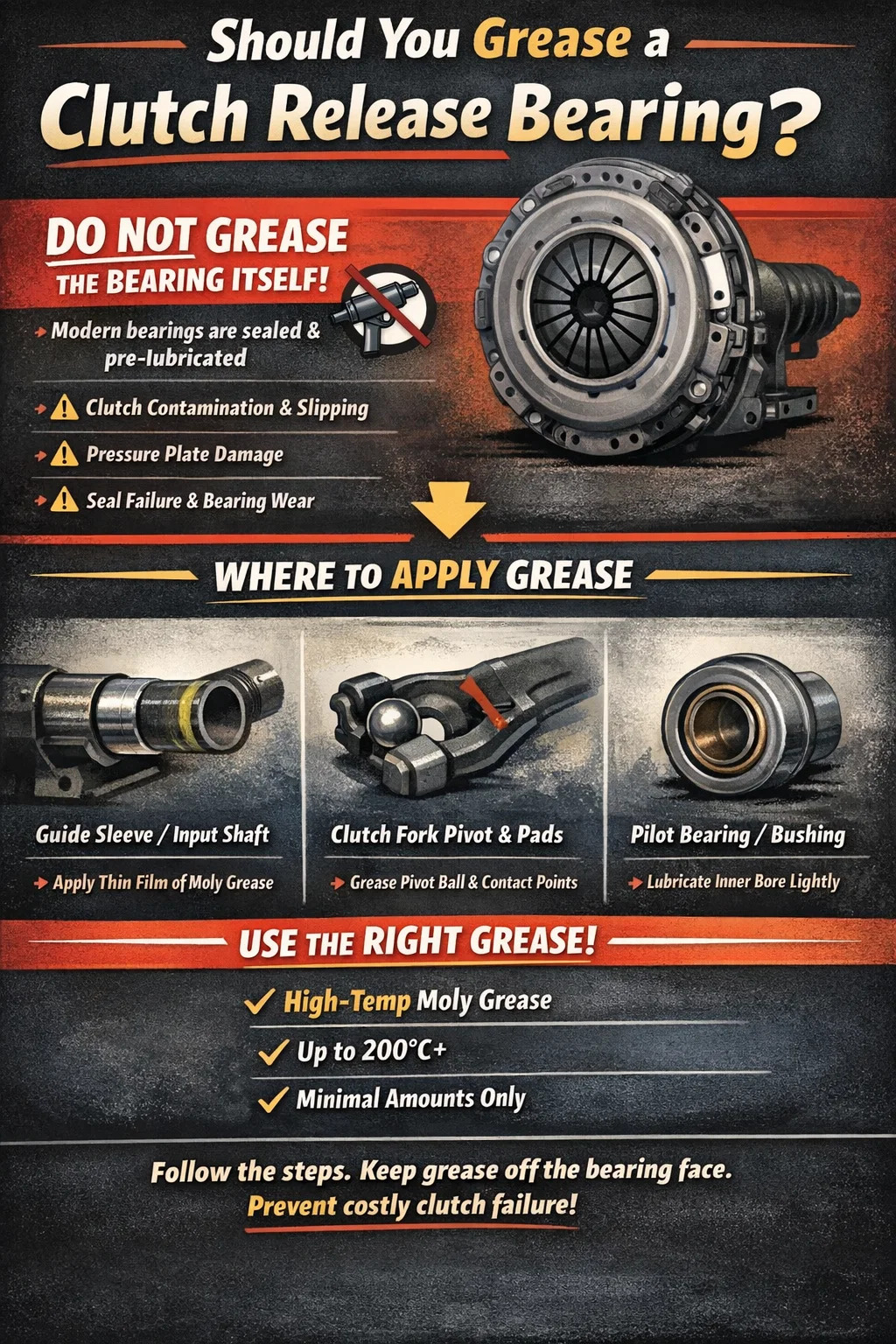
- 3 Why You Should Not Grease the Bearing Itself
- 4 Where Grease Is Required During Clutch Release Bearing Installation
- 5 The Right Type of Grease to Use on Clutch Components
- 6 Step-by-Step: Correct Lubrication During Clutch Release Bearing Installation
- 7 What Happens When You Over-Grease a Clutch Release Bearing Assembly
- 8 Hydraulic Release Bearings: Special Considerations
- 9 Common Myths About Clutch Release Bearing Lubrication
- 10 How Long a Properly Installed Clutch Release Bearing Should Last
- 11 Summary: The Rules for Clutch Release Bearing Lubrication
The Direct Answer: Should You Grease a Clutch Release Bearing?
No, you should not grease a modern clutch release bearing — also called a throw-out bearing — in most cases. The vast majority of clutch release bearings manufactured after the mid-1980s are sealed, pre-lubricated units. They come from the factory with a specific grease already packed inside the bearing races, and that internal lubrication is designed to last the entire service life of the bearing. Adding external grease to a sealed clutch release bearing does nothing to improve its performance and can actively cause damage.
However, there is nuance here that matters. While the bearing itself should not be greased, certain contact points around the clutch release bearing assembly — specifically the fork contact points, the sleeve or guide tube, and the input shaft bearing retainer — do require a small, precise amount of high-temperature grease during installation. Getting this distinction wrong is one of the most common causes of clutch chatter, bearing failure, and premature clutch wear.
This article covers exactly where to apply grease, what type to use, how much is appropriate, and what happens when you get it wrong.
What a Clutch Release Bearing Actually Does
Before discussing lubrication, it helps to understand the mechanical role of the clutch release bearing. When you press the clutch pedal, a mechanical or hydraulic linkage pushes the clutch fork, which in turn pushes the throw-out bearing against the spinning pressure plate fingers (also called diaphragm spring fingers). The bearing allows a stationary component — the clutch fork — to press against a rapidly rotating component — the pressure plate — without grinding them together.
The release bearing typically rides on a guide sleeve that surrounds the transmission's input shaft. In a cable or mechanical linkage system, the bearing only contacts the pressure plate when the pedal is depressed. In many hydraulic systems, the bearing may ride in constant contact with the diaphragm spring fingers, which places even greater demands on the bearing's internal lubrication.
Operating temperatures inside a bell housing can reach 150°C to over 200°C under hard use, and the bearing must handle both rotational load and axial (thrust) load simultaneously. This is why the factory pre-packed grease is specifically engineered for the application — and why substituting it with the wrong external lubricant can cause failure.
Why You Should Not Grease the Bearing Itself
Sealed clutch release bearings have rubber or metal shields on both sides that retain the internal grease and exclude contaminants. When you apply additional grease to the outside of such a bearing, several problems can occur:
- Clutch disc contamination: Excess grease migrates under heat and centrifugal force. If it reaches the clutch disc friction material, the disc becomes glazed or oil-soaked and the clutch slips immediately. Replacing a contaminated clutch disc typically costs $300–$700 in parts alone, not counting labor.
- Pressure plate damage: Grease on the pressure plate friction surface causes uneven engagement, vibration, and accelerated wear of the pressure plate's contact face.
- Seal damage: Many common greases are not compatible with the rubber compounds used in bearing seals. Petroleum-based greases, in particular, can cause seal swelling or degradation, allowing the internal factory grease to leak out and contaminating the bearing itself.
- Bearing overload: Excessive external grease can create drag on the bearing, generating additional heat and shortening its service life rather than extending it.
- Noise issues: Grease applied to the face of the release bearing that contacts the diaphragm spring fingers can cause inconsistent engagement noise and clutch chatter.
The only exception to this rule involves older open-race or serviceable throw-out bearings found in pre-1980s vehicles or in certain agricultural and heavy equipment applications. These units are designed to accept periodic re-greasing and will have an obvious open or semi-shielded construction. If you are working on a vintage vehicle, check your service manual to confirm whether your throw-out bearing is of the serviceable type.
Where Grease Is Required During Clutch Release Bearing Installation
While the bearing body itself gets no grease, several surrounding components must be lubricated during a clutch job. Skipping these steps causes noise, rough pedal feel, and premature wear of the surrounding hardware.
The Input Shaft Bearing Retainer / Guide Sleeve
The clutch release bearing slides back and forth on the guide sleeve or bearing retainer as the clutch pedal is operated. This is a sliding contact between two metal surfaces, and it requires a light film of grease to prevent galling and allow smooth, quiet movement. Apply a very thin, uniform coat of high-temperature grease to the guide sleeve — enough to just cover the surface without any excess that could migrate forward toward the clutch disc.
A common mistake is applying too much grease here. A thin film is all that is needed. Thick blobs of grease will work their way along the shaft under thermal cycling and vibration and can contaminate the clutch disc within a few hundred miles.
The Clutch Fork Contact Points
The clutch fork pivots on a ball stud or pivot point and contacts the release bearing retainer at two points. Both the pivot ball and the fork's contact pads on the bearing retainer need a small amount of grease. These are metal-to-metal contact points under significant lever load, and they will wear rapidly without lubrication. Apply a pea-sized amount of grease to the pivot ball and a light smear to each fork contact pad.
The Clutch Pedal Pivot and Linkage (if accessible)
If you have the transmission out, it is worth checking the clutch pedal bushings, pivot shaft, and any mechanical linkage rods for lubrication while you have access. Squeaking pedals and stiff clutch feel are often caused by dry pivot points rather than anything inside the bell housing.
The Pilot Bearing or Pilot Bushing
This separate bearing sits at the center of the crankshaft or flywheel and supports the tip of the transmission input shaft. It is not part of the throw-out bearing assembly but is always replaced during a clutch job. If you are installing a bronze pilot bushing (rather than a needle roller bearing), apply a light coat of assembly lube or white lithium grease to its inner bore before installation.
The Right Type of Grease to Use on Clutch Components
Not all greases are suitable for clutch applications. The environment inside a bell housing — high heat, vibration, and the catastrophic risk of friction material contamination — demands specific product properties.
| Grease Type | Temperature Range | Suitable for Clutch Use? | Notes |
|---|---|---|---|
| High-temperature molybdenum disulfide (Moly) grease | Up to 200°C+ | Yes — preferred | Excellent for fork pivot ball and guide sleeve; remains stable under heat |
| Lithium complex / white lithium grease | Up to 150–180°C | Yes — acceptable | Good general-purpose option; use sparingly on guide sleeve |
| Copper-based anti-seize compound | Up to 1100°C | Limited — use with caution | Some technicians use it on splines; not ideal near friction surfaces |
| Regular chassis grease (NLGI #2) | Up to 120°C | No | Liquefies at bell housing temperatures; migrates and contaminates clutch |
| Petroleum jelly / Vaseline | Melts below 80°C | No | Far too low a melt point; will immediately contaminate clutch components |
| WD-40 or penetrating oil | N/A | No | Not a lubricant; evaporates and leaves no film; attracts dust |
The industry standard recommendation for clutch release bearing installation is a high-temperature, moly-based grease applied in minimal quantities to the specific contact points described above. Many clutch kit manufacturers, including Sachs, LUK, and Exedy, include a small packet of this type of grease in their clutch kit packages — use what they provide and apply only to the designated points.
Step-by-Step: Correct Lubrication During Clutch Release Bearing Installation
The following procedure applies to a typical rear-wheel-drive vehicle with a mechanical clutch fork. Hydraulic release systems may differ slightly, but the core principles remain the same.
- Remove and inspect all components. With the transmission out and the old clutch removed, clean the bell housing interior, the guide sleeve, and the clutch fork and pivot ball area with brake cleaner. Remove any old grease, rust, or debris. Inspect the guide sleeve for wear grooves or corrosion.
- Apply grease to the guide sleeve. Using a clean rag or gloved finger, apply a thin, uniform film of high-temperature moly grease to the entire length of the guide sleeve that the release bearing will travel on. Wipe off any excess. The surface should look wet, not thick.
- Slide the new release bearing onto the guide sleeve. Confirm that it slides freely and smoothly. If it binds or drags, check for burrs on the sleeve and address them before proceeding.
- Do not apply any grease to the face of the release bearing — the side that contacts the diaphragm spring fingers. This surface must remain dry.
- Grease the fork pivot ball. Apply a pea-sized amount of grease to the pivot ball stud. Spread it around the ball surface.
- Grease the fork contact pads. Apply a small smear of grease to the two ears or contact pads of the clutch fork where they engage the release bearing retainer collar.
- Install the clutch fork, ensuring it seats correctly on the pivot ball and clips or retains onto the release bearing securely.
- Perform a final inspection. Look inside the bell housing and confirm that no excess grease is present near the clutch disc area or on the pressure plate. Wipe away any stray grease before proceeding.
- Complete the installation and verify pedal operation before putting the vehicle back in service.
What Happens When You Over-Grease a Clutch Release Bearing Assembly
Over-greasing during clutch installation is one of the leading causes of what is commonly diagnosed as a "defective clutch" shortly after replacement. The symptoms appear quickly — often within a few hundred miles — and can mimic multiple different problems depending on where the grease migrated.
- Clutch slipping: The most immediate symptom when grease reaches the clutch disc. Engine revs climb without a corresponding increase in vehicle speed, especially under load. The clutch disc must be replaced.
- Clutch chatter or shudder: Partial contamination of the pressure plate or disc produces a vibrating, juddering engagement at low speeds, particularly when pulling away from a stop.
- Burning smell: Contaminated friction material can produce a strong burning odor, especially during initial break-in when residual grease burns off the hot components.
- Bearing noise from excess drag: Over-greased bearing slides can attract metallic particles and grit, leading to accelerated bearing wear and a grinding or rumbling noise when the clutch pedal is depressed.
- Premature release bearing failure: If incompatible grease has degraded the bearing seals, the pre-packed internal lubricant leaks out and the bearing runs dry, typically failing within 10,000–20,000 miles rather than the expected 60,000–100,000 miles.
In worst-case scenarios, over-greasing requires dropping the transmission again and replacing the entire clutch kit — a job that in a shop environment costs between $800 and $1,800 or more depending on the vehicle. The grease packet included in most clutch kits holds just enough product for the job; if you use the whole packet in the right places, you will not over-grease.
Hydraulic Release Bearings: Special Considerations
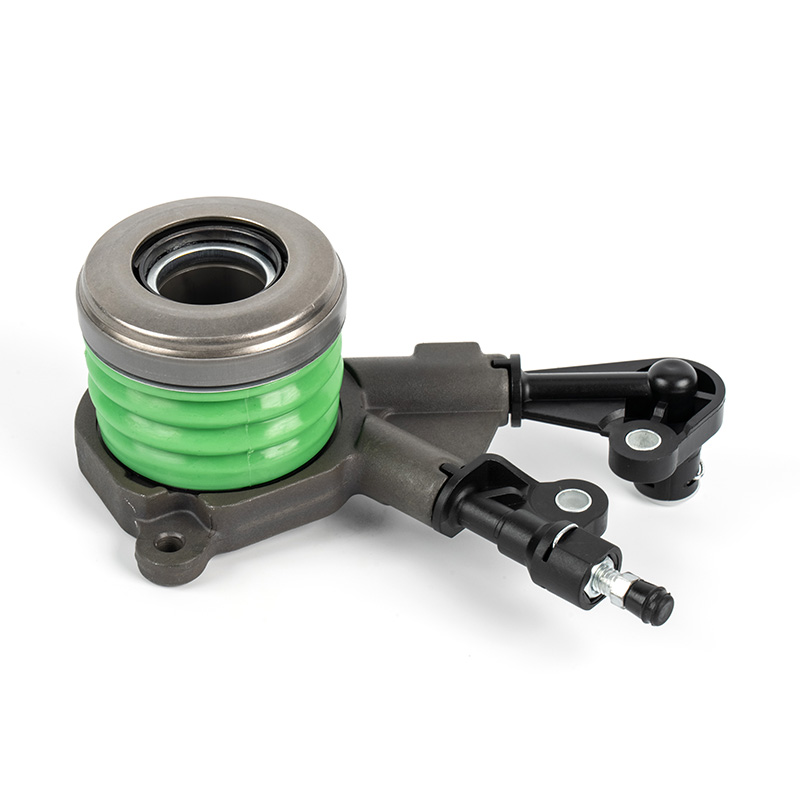
Many modern vehicles use a concentric slave cylinder (CSC) — a hydraulic unit that combines the slave cylinder and the release bearing into a single assembly that mounts directly on the input shaft bearing retainer inside the bell housing. These are increasingly common on European vehicles, modern trucks, and performance cars.
The lubrication rules for CSC units are even stricter than for conventional throw-out bearings. Do not apply any grease to the bearing face or the hydraulic body of a CSC unit. These assemblies are fully sealed and self-contained. The only lubrication point is the guide sleeve, and even then, some manufacturers specify dry installation or a specific silicone-based lubricant to avoid seal compatibility issues with the hydraulic seals inside the CSC.
Always refer to the specific instructions provided with the replacement CSC unit. Getting this wrong can cause hydraulic seal failure inside the bearing unit, leading to fluid loss and clutch system failure — a more serious and expensive outcome than a contaminated friction disc.
Common Myths About Clutch Release Bearing Lubrication
Myth: More Grease Means Better Protection
This is the most widespread misconception. In clutch applications, more grease is not better — it is actively harmful. A thin film provides the necessary lubrication. Excess grease has nowhere to go and migrates toward the friction surfaces.
Myth: You Should Grease the Input Shaft Splines Heavily
The clutch disc hub splines that slide onto the input shaft do need a trace amount of lubricant so the disc can disengage cleanly. However, many professionals now prefer to install these dry or with barely any lubricant at all, because any grease on the splines tends to migrate. If you do apply anything here, use an absolute minimum — a light smear of moly grease on the spline teeth only, then wipe off the excess with a clean rag.
Myth: Bearing Noise Means the Release Bearing Needs Greasing
If your clutch release bearing is making noise — a chirping, grinding, or rattling sound when the pedal is depressed — the bearing needs to be replaced, not greased. A sealed bearing that has developed noise has either failed internally or has worn to the point where re-lubrication is not possible or effective. Attempting to grease it from the outside will not restore a failing sealed bearing.
Myth: Any Grease Will Do in a Pinch
Chassis grease, axle grease, and general-purpose greases all have drop points below the temperatures regularly reached inside a bell housing. Using the wrong product does not just fail to provide protection — it actively introduces a contamination risk as the grease liquefies under heat.
How Long a Properly Installed Clutch Release Bearing Should Last
A quality clutch release bearing, correctly installed with appropriate lubrication at the contact points and no grease on the bearing face itself, should last the life of the clutch kit. In typical passenger car use, that means:
- Standard driving conditions: 60,000 to 100,000 miles, often longer on highway-heavy use where the clutch is operated less frequently.
- Urban stop-and-go driving: 40,000 to 70,000 miles due to the higher clutch operation frequency.
- Performance and track use: Significantly shorter — as little as 20,000 miles depending on operating temperatures and aggressiveness of use.
Because accessing the release bearing requires removing the transmission, it is standard practice to always replace the throw-out bearing whenever a clutch job is performed, regardless of whether the old bearing shows visible wear. The cost of the bearing itself — typically $20 to $80 for most passenger vehicles — is negligible compared to the labor cost of dropping the transmission a second time.
Summary: The Rules for Clutch Release Bearing Lubrication
Getting the lubrication right on a clutch release bearing installation is about precision and restraint, not generosity with the grease gun. Here is the complete summary:
- Do not grease the clutch release bearing itself. Modern sealed throw-out bearings are pre-lubricated for life and require no external grease.
- Do apply a thin film of high-temperature moly grease to the guide sleeve where the bearing slides.
- Do grease the clutch fork pivot ball and fork contact pads with a small, precise amount of the same grease.
- Never put grease on the bearing contact face or on any friction surface.
- Use only high-temperature grease rated for the thermal environment inside a bell housing.
- Follow the clutch kit manufacturer's instructions and use the grease packet provided where specified.
- For hydraulic concentric slave cylinders, consult the product-specific instructions and err toward using less grease or none at all on the guide sleeve.
Following these rules will give a clutch release bearing the best possible service life, ensure smooth and consistent clutch operation, and avoid the costly mistakes that send a perfectly good new clutch straight to the bin.
Related Products
Contact Us

A production enterprise specializing in the production of automobile clutch bearings and other non-standard bearings.
- Contact Information
-
 +86-575-86013311
 -
 +86-575-86013322
 -
 No. 50, Tashan 1st Road, Xinchang County, Shaoxing, Zhejiang, China

Copyrigh t© Xinchang Heyang Auto Parts Co., Ltd.. All Rights Reserved.
China auto bearing manufacturers wholesale auto bearing supplier
