 +86-13867573512
 [email protected]
 Get a quote

 English
  Español
How to Tell if a Bearing Needs to Be Replaced: Key Signs
Author: Heyang Date: Apr 13, 2026
Content
- 1 How to Tell if a Bearing Needs to Be Replaced: The Short Answer
- 2 Unusual Noises: The First and Most Reliable Warning Sign
- 3 Vibration Through the Steering Wheel or Chassis
- 4 Wheel Wobble and the Physical Shake Test
- 5 Steering Drift, Pulling, and Loss of Responsiveness
- 6 ABS Warning Light and Sensor Interference
- 7 Uneven or Abnormal Tire Wear Patterns
- 8 Visual Inspection: What to Look for on the Bearing Itself
- 9 Excessive Heat as a Bearing Failure Indicator
- 10 How Long Do Bearings Actually Last?
- 11 Common Causes of Premature Bearing Failure
- 12 What Happens If You Ignore a Failing Bearing
- 13 Steps to Confirm Bearing Failure Before Replacing
- 14 Replacement Cost: What to Expect
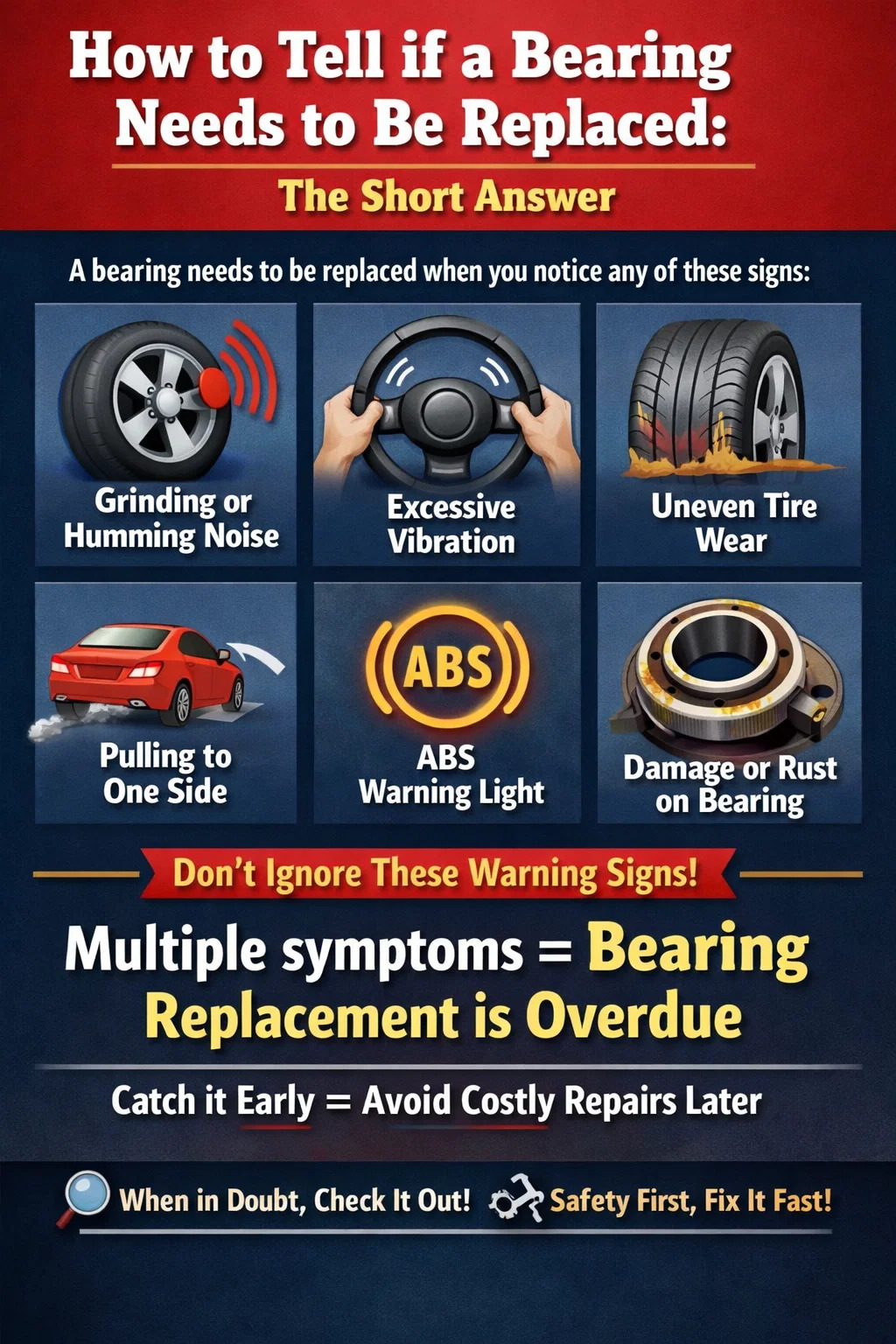
How to Tell if a Bearing Needs to Be Replaced: The Short Answer
A bearing needs to be replaced when you notice one or more of the following: persistent grinding, humming, or growling noises that change with speed, unusual vibrations through the steering wheel or chassis, uneven or accelerated tire wear, the vehicle pulling to one side under braking, or visible physical damage such as rust, pitting, or discoloration on the bearing surface. In automotive contexts, an illuminated ABS warning light can also point directly to a failing wheel bearing. Any single symptom deserves investigation; multiple symptoms appearing together almost always mean replacement is overdue.
Bearings — whether wheel bearings, industrial roller bearings, or machine spindle bearings — share the same job: minimizing friction between moving parts while carrying radial and axial loads. When that function degrades, the consequences range from annoying noise all the way to catastrophic mechanical failure. Understanding the exact warning signs, and knowing how to confirm them, is the difference between catching a $150 bearing swap early and facing a $1,000+ repair bill later.
Unusual Noises: The First and Most Reliable Warning Sign
Noise is the earliest and most frequently reported indicator that a bearing is failing. The sound changes depending on how far the damage has progressed and what type of bearing is involved, but a few patterns are consistent across almost every application.
Humming and Droning That Changes With Speed
A low, cyclic hum that rises and falls with vehicle speed — rather than engine speed — is one of the most telling symptoms of a worn wheel bearing. The noise comes from slight irregularities in the bearing race or rolling elements that generate vibration as they spin. If you accelerate from 40 mph to 70 mph and the hum becomes noticeably louder, the bearing is a prime suspect. The same principle applies to industrial machinery: a bearing running a conveyor or motor shaft will produce an increasingly prominent drone as internal clearances grow.
Grinding, Growling, and Metal-on-Metal Contact
Grinding is a more serious sign than humming. It typically means the bearing's lubrication has failed, the rolling elements or raceways are pitted, or the seals have been compromised and debris has entered the bearing housing. At this stage, metal-on-metal contact is occurring with every rotation. On a vehicle, you may hear this grinding most clearly during turns or when shifting weight, because cornering loads more heavily on one side of the bearing assembly. In a machine, grinding indicates the bearing is in an advanced failure state and should be taken offline immediately.
Clicking, Squealing, and Cyclic Chirping
Clicking that happens at a rhythmic interval matching wheel rotation often points to a damaged CV joint or a chipped rolling element inside the bearing. Squealing — sometimes described as a bird-chirping sound — can occur when the bearing cage is deformed or when the bearing races are running dry. These sounds tend to be most noticeable at low speeds and may briefly disappear at highway speeds, which can mislead owners into thinking the problem has resolved on its own. It has not.
Diagnosing Which Bearing Is Noisy Using the Swerve Test
For wheel bearings specifically, a simple swerve test can help identify which side is failing before you even lift the vehicle. While driving at highway speeds between 50 and 70 mph, gently and smoothly shift your lane position left and right. When you steer left, weight transfers to the right wheels, loading the right-side bearing. If the humming or droning increases as you move right, the left-side bearing is likely the problem — and vice versa. This test works because loading a deteriorating bearing exaggerates the noise while momentarily unloading the opposite side reduces it. Perform the test in a safe, open area with minimal traffic.
Vibration Through the Steering Wheel or Chassis
Vibration is another strong indicator that a bearing has worn beyond acceptable tolerances. Unlike tire imbalance — which typically produces a steering wheel shake at a specific speed range (commonly between 60 and 70 mph) that disappears at higher speeds — bearing-related vibration tends to worsen progressively as speed increases and does not self-correct.
A deteriorating wheel bearing introduces excessive play into the hub assembly. As the internal clearances grow, the wheel can no longer maintain a perfectly consistent contact patch with the road. The resulting instability travels up through the suspension and steering column, often felt as a constant or pulsing shudder that is most pronounced during cornering or lane changes. In industrial equipment, vibration that was not present during commissioning — or that has gradually worsened over time — is treated as a definitive signal to inspect all bearings in the affected shaft or housing.
Vibration analysis tools used in predictive maintenance programs can detect bearing defects well before they become audible, measuring frequency signatures associated with specific failure modes such as inner race damage, outer race damage, or rolling element spalling. For the average vehicle owner without access to such equipment, trusting the physical sensation and pairing it with other symptoms is the practical approach.
Wheel Wobble and the Physical Shake Test
Excessive play in the wheel hub is one of the most straightforward signs that a wheel bearing has reached a critical state. You can confirm this at home with a simple physical inspection that requires no tools.
Safely raise the vehicle using a floor jack and secure it with jack stands. Never rely solely on a scissor jack for this test. Once the wheel is off the ground, grip the tire firmly at the 12 o'clock and 6 o'clock positions and attempt to rock it toward and away from you. Then move your grip to the 3 o'clock and 9 o'clock positions and repeat the test. A properly functioning wheel bearing should exhibit zero perceptible movement. Any detectable wobble, clunking, or looseness — even a small amount — indicates that the bearing has lost its ability to hold the wheel assembly securely in place and must be replaced without delay.
When wobble is present at highway speeds, the effect is amplified. Drivers may notice a floating or darting sensation in the steering, as if the front of the vehicle is not tracking true. This is not a symptom to monitor and revisit — a wheel with excessive bearing play can, under extreme conditions, separate from the vehicle entirely. Published accident reports confirm that complete wheel bearing failures have caused catastrophic loss of control at highway speeds.
Steering Drift, Pulling, and Loss of Responsiveness
A vehicle that pulls consistently to one side while driving, or that drifts during braking, may have a failing wheel bearing on the side it drifts toward. As a bearing deteriorates, it creates uneven rolling resistance on the affected wheel. That resistance disrupts the vehicle's ability to track straight, placing asymmetric forces on the drivetrain and steering geometry.
The difficulty with this symptom is that it overlaps with several other common issues, including brake caliper drag, uneven tire pressure, or misaligned wheels. If an alignment check comes back clean, tire pressures are correct, and the brakes show no signs of sticking or uneven wear, the wheel bearing is the next logical suspect. A mechanic who lifts the vehicle and spins each wheel by hand can often identify a binding or rough-feeling bearing simply by feel and sound during that manual rotation test.
Loose or wandering steering — where the vehicle no longer responds with the crisp, direct feel it had when new — can also indicate bearing wear, particularly when combined with other symptoms. Healthy wheel bearings keep the hub assembly rigid; worn ones allow microscopic movement that softens the steering feel and delays the vehicle's response to driver inputs.
ABS Warning Light and Sensor Interference
Modern vehicles integrate the wheel speed sensor for the anti-lock braking system directly into or adjacent to the wheel bearing hub assembly. This design means that a failing bearing can directly interfere with ABS sensor performance. As the bearing wears and internal clearances increase, the sensor's relationship to the tone ring (the toothed ring it reads to calculate wheel speed) becomes inconsistent. The ECU receives erratic or missing speed data from that corner and illuminates the ABS warning light on the dashboard.
It is worth noting that the ABS light can illuminate from a bearing problem even when the vehicle is not braking and no wheel slip is occurring. If an ABS or traction control warning appears without any obvious driving event that would cause it, and clears and returns intermittently, the wheel bearing is a high-priority item to inspect. An OBD-II scan will typically show a wheel speed sensor fault code, and the wheel it points to is the one that needs the bearing inspected first.
Uneven or Abnormal Tire Wear Patterns
Tires wear evenly when the wheel is properly aligned and the hub assembly holds the wheel at a consistent, correct angle relative to the road surface. A worn bearing introduces play into the hub, which allows the wheel to tilt slightly — particularly under load. That tilt causes the tire to contact the road at a slight angle, concentrating wear on one edge rather than distributing it across the full tread width.
If one tire is wearing faster than its counterpart on the opposite side of the same axle, or if you notice excessive wear on the inner or outer shoulder of a single tire without any corresponding alignment problem, the wheel bearing on that corner deserves attention. This symptom develops gradually and becomes visible well after the bearing has begun to fail, meaning the wear pattern itself confirms the problem has been present for some time.
Continuing to drive on a bearing that is causing abnormal tire wear accelerates the rate of tire damage. Beyond the added cost of premature tire replacement, the reduced tread depth on one section of the tire compromises wet-weather handling and braking performance — compounding the risk that already comes with a failing bearing.
Visual Inspection: What to Look for on the Bearing Itself
When a bearing is accessible for direct inspection — as is the case with open industrial bearings, tapered roller bearings on trailers, or bearings that have been removed from a hub — visual examination provides definitive evidence of whether replacement is necessary.
| Damage Type | What It Looks Like | What It Means | Action |
|---|---|---|---|
| Spalling / Pitting | Flaked or cratered surface on races or rolling elements | Fatigue failure; rolling contact stress exceeded material limit | Replace immediately |
| Heat Discoloration (Bluing) | Blue, straw, or brown tint on metal surfaces | Overheating has altered the metal's hardness; structural integrity compromised | Replace immediately |
| Rust and Corrosion | Red-brown surface oxidation, often with pitting | Moisture has breached the seal; corrosion spreads and weakens the structure | Replace immediately |
| Brinelling | Indentations in the raceway matching rolling element spacing | Impact or static overload has permanently deformed the race surface | Replace; also investigate root cause |
| Grease Contamination | Dark, gritty, or dried-out grease; metallic particles visible | Lubrication has failed; debris is accelerating internal wear | Replace bearing; clean housing thoroughly |
| Cage Damage | Cracked, deformed, or broken retainer cage | Rolling elements no longer evenly spaced; catastrophic failure imminent | Replace immediately; do not run |
Any of the damage types in the table above is sufficient grounds for replacement on its own. There is no partial repair for a bearing that shows spalling, heat discoloration, or a cracked cage. The economics are straightforward: the cost of a new bearing is always less than the cost of the secondary damage caused by running a bearing to complete failure.
Excessive Heat as a Bearing Failure Indicator
Abnormal heat generation is a key diagnostic signal in industrial bearing applications and is increasingly relevant in automotive maintenance as well. Bearings run hotter than ambient temperature under normal conditions — a modest rise of 10°C to 30°C above ambient is generally acceptable depending on the application. Temperatures significantly above the manufacturer's rated operating range indicate a problem.
In industrial settings, infrared thermometers and thermal imaging cameras are commonly used to baseline bearing temperatures during normal operation and flag units running abnormally hot during routine inspections. On vehicles, a wheel hub that feels noticeably hot — or even warm — shortly after driving a short distance at moderate speed can indicate a bearing that is binding or running without adequate lubrication. This same heat can damage adjacent components including brake rotors, caliper seals, and hub seals, turning what was a single bearing replacement into a more extensive repair.
Overheating can also be detected indirectly. A burnt smell after driving, particularly near one wheel, is worth taking seriously. Once a bearing has been subjected to excessive heat, the hardening treatment applied to the steel during manufacturing is compromised. The softer metal then wears faster, meaning even a newly re-greased bearing that has been overheated will fail far sooner than one that was kept within its thermal limits. Replacement becomes unavoidable at that point regardless of how the bearing looks superficially.
How Long Do Bearings Actually Last?
Bearing lifespan depends heavily on application, load, lubrication quality, sealing effectiveness, and operating environment. Understanding the realistic service life for your specific use case helps set appropriate inspection intervals rather than waiting for symptoms to appear.
- Automotive wheel bearings: Most last between 75,000 and 150,000 miles under normal conditions. Vehicles that regularly travel on rough, unpaved roads or in regions where roads are heavily salted in winter can see premature failure well before the 75,000-mile mark. Wheel bearing failures have been documented at fewer than 50,000 miles in vehicles driven regularly through deep water, sand, or heavily salted roads where moisture penetrates the seals.
- Industrial rolling element bearings: L10 rated life (the point at which 10% of a population of bearings is expected to fail) varies enormously by load and speed. A lightly loaded, properly lubricated bearing in a clean environment may run for tens of thousands of hours. The same bearing operating at its maximum rated load in a contaminated environment may fail in a fraction of that time.
- Bicycle and small equipment bearings: These typically require inspection every 1,000 to 5,000 hours of use depending on conditions, with replacement triggered by roughness during manual rotation or any perceptible play.
Rather than planning replacements on mileage or time alone, the more reliable approach is to combine interval-based inspection with symptom monitoring. A bearing that shows no symptoms and passes a physical inspection at its scheduled service interval can continue in service. One showing even early symptoms should be replaced at the first opportunity regardless of how recently it was installed or how few miles are on it.
Common Causes of Premature Bearing Failure
Understanding why bearings fail prematurely helps avoid repeating the conditions that caused the first failure — and informs whether the replacement bearing needs to be of a different type or specification.
- Lubrication failure: Inadequate grease volume, the wrong grease type, degraded grease that has lost its viscosity, or a failed seal that has allowed grease to escape are all direct paths to bearing failure. Lubrication issues are estimated to be the root cause in roughly 36% of industrial bearing failures.
- Contamination: Dirt, water, metal particles, and road salt entering the bearing housing are major contributors to accelerated wear. In automotive applications, a compromised hub seal is the most common entry point. In industrial settings, contamination can enter during installation or through failed labyrinth seals.
- Improper installation: Bearing damage that occurs during installation — from being hammered into place, driven on the wrong race, misaligned during pressing, or installed without the correct preload — often does not manifest until miles or hours into service. Using the correct bearing press, applying force only to the appropriate ring, and verifying fit against manufacturer specifications prevents this category of failure entirely.
- Overloading: Running bearings beyond their rated dynamic or static load capacity accelerates raceway fatigue. In vehicles, oversized or excessively wide aftermarket tires can place significantly greater loads on the wheel bearings than they were designed to handle, shortening service life even when installation and lubrication are correct.
- Impact damage: A single severe pothole strike, curb impact, or collision can cause brinelling — permanent indentation of the bearing races — that immediately shortens the remaining service life. If a vehicle has sustained a significant impact to a corner, the wheel bearing on that corner should be inspected even if no noise or vibration is immediately apparent.
What Happens If You Ignore a Failing Bearing
Delaying bearing replacement rarely saves money. The degradation is progressive, and the longer a bearing is allowed to run in a damaged state, the more damage it inflicts on adjacent components.
In a vehicle, a failing wheel bearing can damage the hub assembly, the axle shaft, the brake rotor, and the ABS sensor — components that can cost several times more to replace than the bearing alone. At the extreme end of failure, the wheel can separate from the vehicle. This is not a theoretical risk: documented cases exist of wheel-off incidents at highway speeds caused by bearing failures that were preceded by weeks of ignored warning signs.
In industrial machinery, an undetected bearing failure can cause shaft damage, housing damage, gear damage, and unplanned production downtime. Studies from manufacturing environments have shown that unplanned downtime from equipment failure can cost between 5 and 20 times more than the same work performed as planned maintenance. A replacement bearing that costs $20 to $200 should never be allowed to cause a machine seizure that takes a production line offline for days.
Uneven tire wear caused by bearing play leads to the need for earlier tire replacement — adding another cost to the tally. Fuel efficiency also decreases as a binding or rough bearing forces more energy to be expended simply rotating the wheel or shaft it supports.
Steps to Confirm Bearing Failure Before Replacing
Before spending money on a replacement, it helps to confirm the bearing is actually the source of the symptoms. Several of the signs described above are shared with other common failures, and a methodical approach avoids unnecessary repairs.
- Road test: Drive at various speeds and note whether noise or vibration changes with vehicle speed (bearing) or engine speed (drivetrain). Perform the swerve test to identify which side is affected.
- Physical shake test: Raise the vehicle safely and check each wheel for play at 12/6 and 3/9 o'clock positions. Any movement indicates bearing play.
- Spin test: With the vehicle raised, spin each wheel by hand. A failing bearing will feel rough, produce a grinding sensation, or emit audible noise during hand rotation. A good bearing spins smoothly and quietly.
- OBD-II scan: If the ABS light is on, scan for codes. Wheel speed sensor fault codes point to the affected corner and confirm bearing involvement when combined with other symptoms.
- Tire inspection: Check for uneven wear patterns. Isolate whether the wear is on the tire corresponding to the suspected bearing location.
- Temperature check: After a short drive, use an infrared thermometer to compare hub temperatures across all four corners. A reading significantly higher at one location — while the vehicle was not braking asymmetrically — points to a problem at that corner.
Two or more of these checks confirming the same corner is the definitive standard for proceeding with replacement. If only one test suggests a problem, further investigation or a professional assessment is worth pursuing before committing to the repair.
Replacement Cost: What to Expect
Bearing replacement costs vary substantially by vehicle type, bearing design, and labor market. Having realistic expectations prevents sticker shock and helps evaluate whether a quoted price is reasonable.
- Standard passenger car, bolted hub assembly: Approximately $250 to $450 per wheel including parts and labor. The bearing and hub arrive as a single pre-assembled unit and bolt directly onto the steering knuckle, requiring moderate labor.
- Pressed-in wheel bearings: These require specialized press equipment to remove the old bearing from the hub and install the new one. Labor costs run higher — typically $350 to $550 per wheel — because the hub must often be removed from the vehicle and taken to a press.
- Luxury vehicles and EVs: Hub assemblies for premium brands and electric vehicles can cost $700 or more per wheel, partly due to the higher cost of OEM parts and the integration of ABS sensors and other electronics into the hub.
- Light trucks and larger SUVs: Can run $600 to $1,200 per axle end, with some heavy-duty truck applications exceeding that figure.
One cost-saving point worth knowing: if a bearing fails on one side of an axle, it is generally not necessary to proactively replace the bearing on the opposite side unless it is showing its own symptoms. Unlike tires, where symmetric replacement is recommended to maintain even tread depth, wheel bearings are independent components and unaffected by a failure on the other side of the same axle.
Related Products
Contact Us

A production enterprise specializing in the production of automobile clutch bearings and other non-standard bearings.
- Contact Information
-
 +86-575-86013311
 -
 +86-575-86013322
 -
 No. 50, Tashan 1st Road, Xinchang County, Shaoxing, Zhejiang, China

Copyrigh t© Xinchang Heyang Auto Parts Co., Ltd.. All Rights Reserved.
China auto bearing manufacturers wholesale auto bearing supplier
